
Nobody taught me how to start investing. Not in school, not at home, not at my first job. I found out at 26 that my coworkers already had 401(k) accounts. I casually mentioned I hadn’t enrolled yet.
The look on their faces told me everything. Two years of employer match , gone.
The moment pushed me to learn what I should have done from day one. I didn’t find investing itself difficult. Instead, I struggled more with the terminology. Instead, it was the terminology. Roth vs traditional. Index funds vs mutual funds. Expense ratios. Asset allocation. Every article I read seemed to assume I already knew what I was doing. I didn’t. And I suspect a lot of people reading this don’t either. That’s exactly why I’m writing this. I’m writing it in the way I wish someone had explained it to me.
This guide covers how to start investing from zero , which accounts to open first, what to put in them, how to think about growth stocks versus value stocks, how to approach real estate, and what mistakes will cost you years of compounding if you fall into them. Let’s go.
Why Starting Matters More Than Starting Perfectly
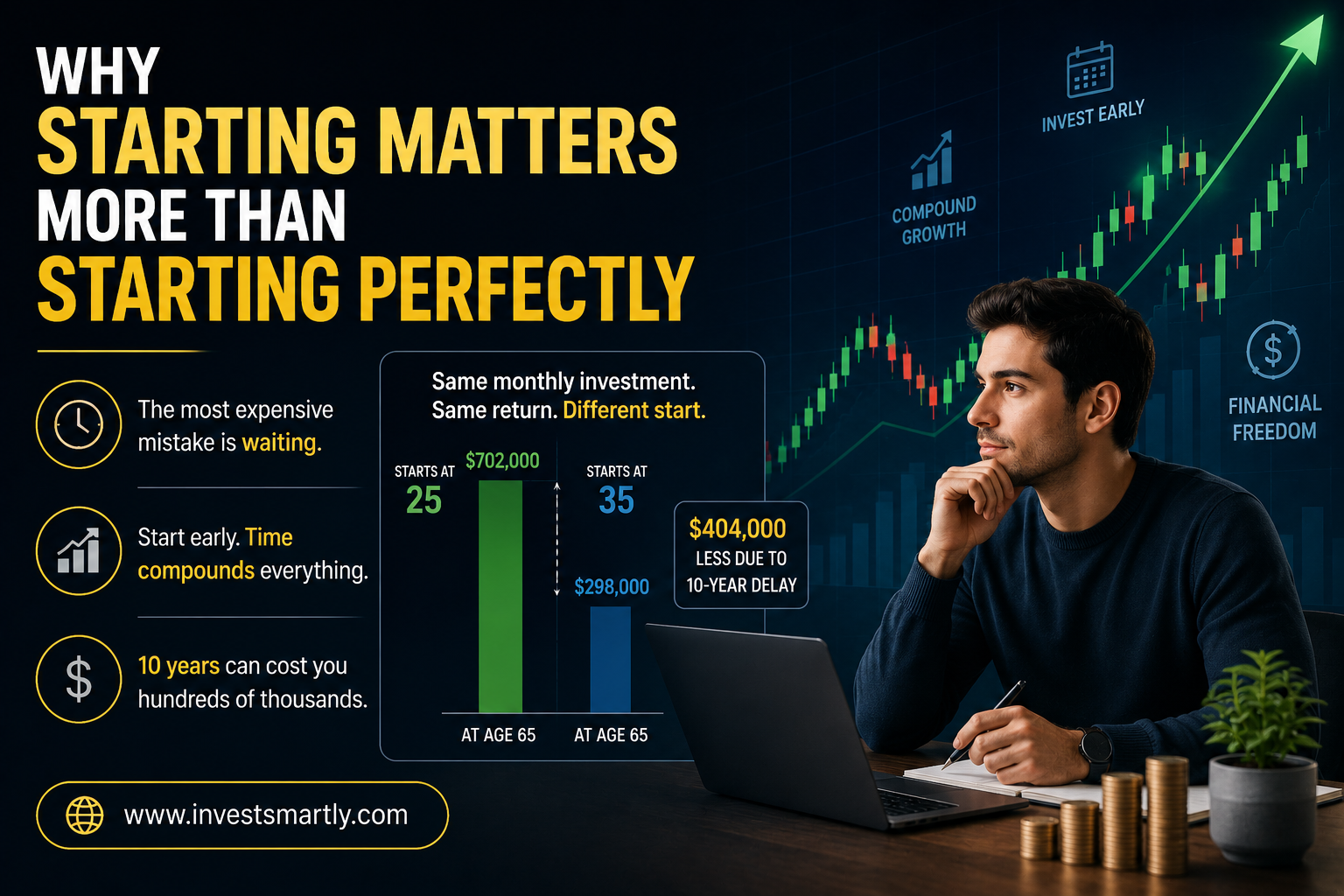
The most expensive investing mistake most Americans make is waiting. They keep waiting until they understand more. Meanwhile, they also wait for the market to settle and save more money first. Every year of delay has a real dollar cost , and it compounds the same way returns compound, just in reverse.
Here’s the math that changed my perspective on how to start investing: two investors both invest $200 per month at an 8% average return. Investor A starts at 25, while Investor B starts at 35. By age 65, Investor A has approximately $702,000. In comparison, Investor B has around $298,000. Both invest the same amount every month and earn the same return. However, Investor B ends up with $404,000 less because of a 10-year delay. That’s the real cost of waiting.
This is why good investment planning starts with urgency. However, that doesn’t mean you should make risky decisions. In investing, time is the one thing you can never get back. Every month you wait is a month of compounding you lose permanently.
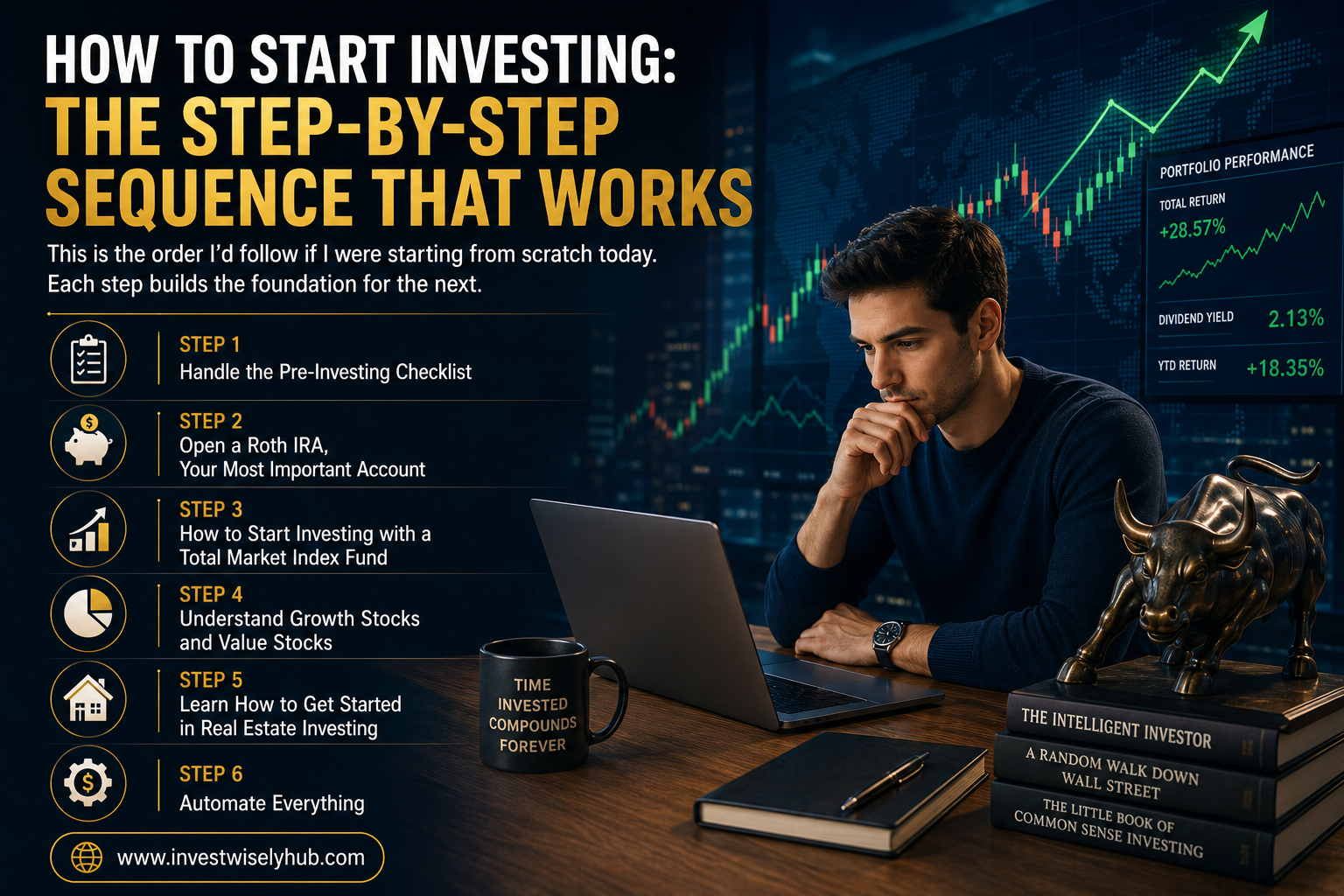
How to Start Investing: The Step-by-Step Sequence That Works
This is the order I’d follow if I were starting from scratch today. Each step builds the foundation for the next.
Step 1: Handle the Pre-Investing Checklist
Before following How to Start Investing, set up three things first. First, pay off high-interest debt like credit cards above 18% APR. Next, build a 3–6 month emergency fund in a high-yield savings account. Finally, keep a small monthly cash surplus. As a result, you won’t need to withdraw investments during emergencies.
However, there is one exception. Always contribute to your 401(k) up to the employer match, even if you have debt. An employer match is an immediate 50–100% return. Nothing you can invest in beats that. First, capture the employer match. Then, pay off high-interest debt. After that, build your emergency fund. Finally, start investing more broadly.
Step 2: Open a Roth IRA , Your Most Important Account
For most Americans under 50, the Roth IRA is the most powerful investment account available. You contribute after-tax dollars, and everything , gains, dividends, and qualified withdrawals in retirement , comes out completely tax-free. The 2026 contribution limit is $7,000/year for those under 50.
If you’re learning how to start investing, opening an account at Fidelity or Vanguard is one of the easiest first steps. It takes about 15 minutes online, requires no minimum balance at Fidelity, and gives you immediate access to low-cost or zero-fee index funds. If your income is too high to contribute directly to a Roth IRA (over $161,000 for single filers in 2026), you can consider the backdoor Roth IRA strategy, a legal and commonly used option among higher earners.
Step 3: How to Start Investing with a Total Market Index Fund
Your first investment should be simple: a total US stock market index fund. At Fidelity, that’s FZROX , zero expense ratio, instant diversification across thousands of US companies, no minimum investment. At Vanguard, it’s VTSAX or VTI. This single fund is a complete portfolio for many beginning investors and will outperform most more complex strategies over a 20-year period.
As you learn How to Start Investing, once that’s running, add international exposure with FZILX (Fidelity) or VXUS (Vanguard) for geographic diversification, and a bond index fund like FXNAX or BND for stability as your portfolio grows. That three-fund combination covers the world’s investable market at essentially zero cost.
Step 4: Understand Growth Stocks and Value Stocks
As you get comfortable with how to start investing, you’ll begin hearing about different types of stocks. Companies such as Nvidia, Microsoft, or Amazon often reinvest profits into expansion instead of paying dividends, which can lead to strong long-term returns but also higher volatility. They often trade at high price-to-earnings ratios because investors are paying for future growth potential.
Value stocks are established companies trading below what analysis suggests they’re worth , banks, energy companies, consumer staples. They tend to be less volatile, often pay regular dividends, and attract investors looking for income and stability over aggressive growth. Warren Buffett built his fortune on value investing principles. A broad index fund already holds both in proportion to their market size, which is one reason it’s the ideal starting point.
Step 5: Learn How to Get Started in Real Estate Investing
As you learn How to Start Investing, real estate is another major wealth-building option to consider alongside stocks. If you want to get started in real estate investing without a large down payment or property management headaches, REITs can be a simple solution. A REIT ETF like VNQ (Vanguard Real Estate ETF) gives you dividend-generating real estate exposure for the price of one share—without any landlord responsibilities.
As you learn How to Start Investing, direct real estate ownership is another option. One beginner-friendly strategy is house hacking—buying a 2–4 unit property with an FHA loan, living in one unit, and renting out the others. When done well, rental income can offset much or even all of your mortgage payment while you build equity over time. It requires more effort than investing in index funds, but many investors have used it as a powerful long-term wealth-building strategy.
Step 6: Automate Everything
If you are serious about how to start investing, set up automatic transfers from your checking account to your investment account every month. Try to choose the same date, preferably right after payday. Automatic investing helps you remove emotions from your decisions. It also makes it easier to stay consistent when the market goes up and down.
When your money is invested automatically, market drops start to feel like buying chances instead of reasons to panic.
Beginner Investing Mistakes That Are Completely Avoidable
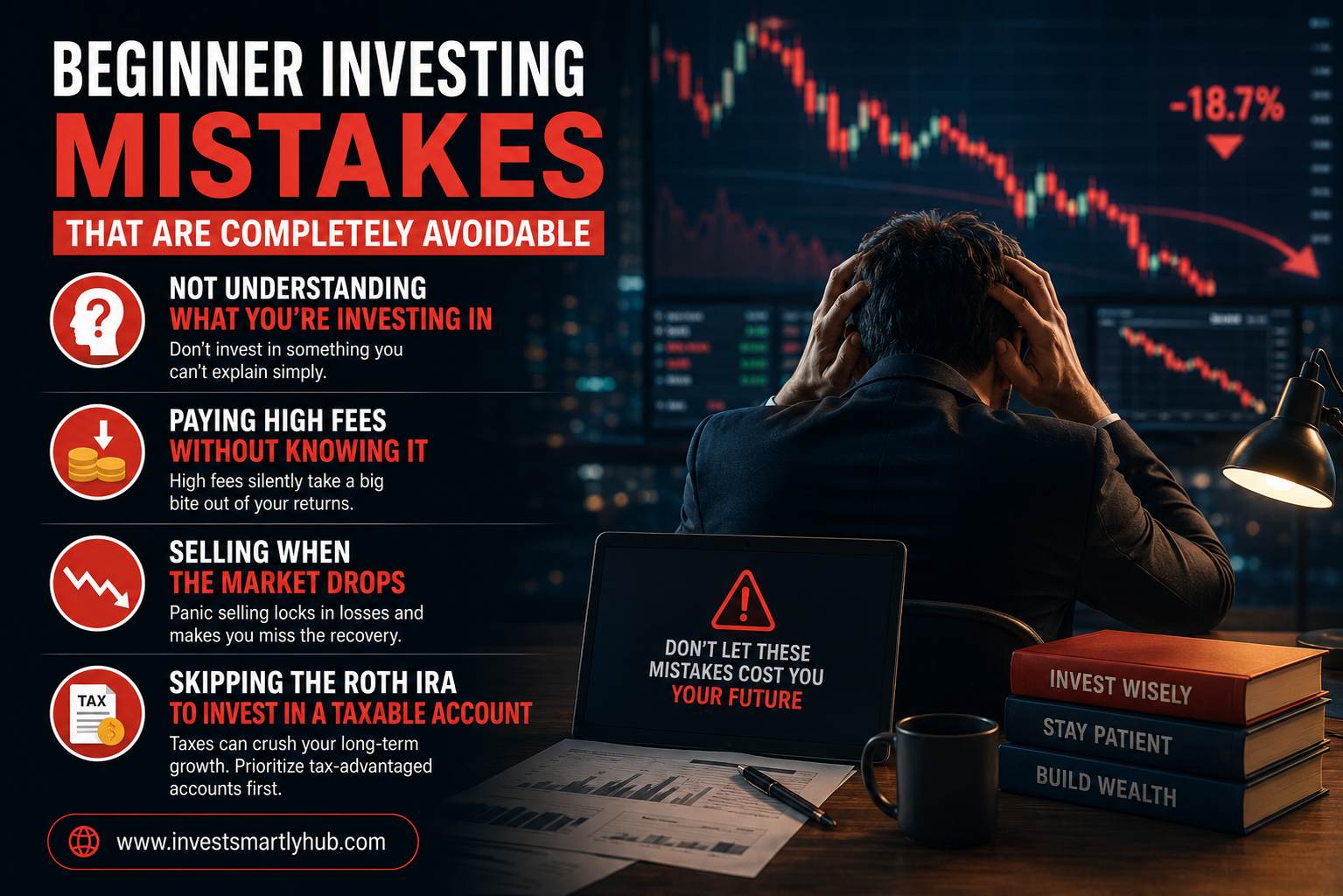
I made some of these. Here’s what to watch for before you lose real money learning the hard way.
Not understanding what you’re investing in.
When learning How to Start Investing, remember that buying a stock just because someone on Reddit recommended it is not investing—it’s speculation. You are taking risk without understanding the business, its value, or why the price may rise. If you cannot explain in one simple sentence why you own a stock, then you should not own it yet.
Paying high fees without knowing it.
Many workplace 401(k) plans have high-fee active funds. A 1% fee looks small, but it reduces your returns over time. Over 30 years, it can cut your final money by about 25–30% compared to a low-cost index fund with a 0.03% fee.
So always check the fee (expense ratio) of every fund you invest in.
Selling when the market drops.
When learning How to Start Investing, remember that every major U.S. market decline has eventually been followed by a recovery that moves above the previous high. Selling during a downturn locks in losses and can cause you to miss the rebound, which is where much of the market’s long-term growth occurs. For example, investors who stayed invested through the 2020 COVID crash and the 2022 rate-hike selloff generally performed better than those who sold in panic and tried to time the market.
Skipping the Roth IRA to invest in a taxable account.
Many beginners open a taxable brokerage account before they max out their Roth IRA because it feels more “real.” However, this is usually not the best move.
When learning How to Start Investing, avoid putting money into a taxable account while your Roth IRA is still unused. In a taxable account, you pay taxes on dividends and capital gains, which can reduce long-term returns. Because of this, it’s usually better to maximize tax-advantaged accounts first and then invest in taxable accounts afterward.
What to Realistically Expect When You Start Investing
Year one is almost always anticlimactic. Your balance is still small, so even normal market changes feel big compared to what you’ve invested. At this stage, the results do not look impressive yet, and that is completely normal. Year one is mainly about building the habit. It is also about choosing the right account structure and learning how to invest regularly. Most importantly, it is about going through market ups and downs without making emotional decisions.
As you continue learning how to start investing, years three through five are usually when compounding starts to feel real. Your portfolio becomes large enough that good market years can add meaningful growth, even if you don’t increase your contributions. Reinvested dividends also start to become more noticeable during this stage. In addition, your automatic investing system begins to feel like it is actually working, and in reality, it is.
Years ten through twenty-five are where long-term investors really pull ahead. This is the stage where consistency starts to show powerful results compared to people who delayed starting. For example, a 27-year-old who invests $400 every month at an average 8% return could have around $237,000 by age 42 and about $595,000 by age 52. In total, they would only contribute $120,000 over 25 years. The remaining $475,000 comes from compound growth. That is what starting early actually looks like over time.
Best Platforms for How to Start Investing in the US Today
Here’s exactly where I’d point someone starting from zero:
- Fidelity (free, zero minimums) , Open a Roth IRA and invest in FZROX and FZILX. These funds have zero fees, no account minimums, and no trading commissions.
Also, Fidelity Investments offers one of the easiest platforms for beginners. That is why it is a strong choice for anyone starting their investing journey in 2026. - Vanguard (free) , For anyone learning how to start investing, Vanguard is often seen as one of the best platforms for long-term index fund investing. Their ETFs, like VTI, VXUS, and BND, have no minimum investment requirement and can be traded without commission fees.
It is a great choice for investors who want a simple, low-cost, and beginner-friendly investing approach. - Ally Bank HYSA (free) , Build your emergency fund before you start investing. Choose a high-yield savings account with a competitive APY, FDIC insurance, no fees, and easy access to your money.
Try to save 3–6 months of expenses here first. Then, once your savings are ready, start putting money into the market.
For a breakdown of the different investment vehicles available once you have your accounts open, 7 types of investments: best options for beginners to build wealth is the natural next read.
Once you’re ready to build a structured long-term plan around your investments, investment planning for beginners: a complete 2026 guide to build long-term wealth walks you through the full roadmap.
And if you want to see how your investments eventually generate income that replaces your active earnings, the ultimate guide to passive income investments for financial freedom shows you where the journey leads.
The Bottom Line
Learning how to start investing is actually simple. First, choose the right account. Then, invest in low-cost index funds and add money regularly. Over time, these small steps can make a big difference.
Also, try to automate your investments so you stay consistent. Most importantly, stay patient when the market goes up and down. Investing can feel confusing later, but building the habit comes first. A strong foundation is what matters most.
Stop waiting for the perfect time, the perfect amount of money, or the perfect level of knowledge. The best time to start is today. First, open your account and make your first investment. Then, stay consistent and let time grow your money step by step.
Also, keep exploring Native Money for honest and practical investment guides. Whether you are a beginner or already investing, you can find helpful tips for every stage of your journey.
FAQ: How to Start Investing in 2026
How do I start investing with no experience?
If you’re wondering how to start investing, start by opening a Roth IRA at Fidelity. It offers zero minimums and zero-fee index funds. Then, invest in FZROX, a total US market index fund. This fund gives you instant diversification across thousands of companies. After that, set up an automatic monthly contribution, even if it’s only $50. With this simple step, your long-term investment portfolio can start growing through automation and compounding.
How to start investing with little money?
When learning How to Start Investing, remember that you can begin with as little as $1 at Fidelity. It has no minimum balance requirement for Roth IRAs and offers fractional shares. Even investing $50 per month at an 8% average return can grow to more than $75,000 over 30 years. This shows that consistency matters more than starting with a large amount. Meanwhile, M1 Finance requires a $100 minimum and automates much of the investing process.
What is the difference between growth stocks and value stocks for beginners?
Growth stocks are companies that grow faster than average. Most operate in technology and innovation sectors. Instead of paying dividends, they reinvest profits back into the business. As a result, they can offer high returns. However, they also come with higher risk and volatility.
Value stocks are established companies like banks, utilities, and consumer staples. They usually trade below their estimated value. In addition, they often pay dividends and have more stable price movements. For beginners learning how to start investing, a total market index fund is a simple choice. It automatically includes both growth and value stocks.
How do I get started in real estate investing as a beginner?
As part of How to Start Investing, one of the easiest ways to begin real estate investing is through REIT ETFs. For example, you can buy VNQ or SCHH in any brokerage account for the price of a single share. As a result, you can start earning quarterly real estate dividend income without owning or managing physical property.
For direct property investing, house hacking is one of the easiest strategies for beginners. First, buy a 2–4 unit property with an FHA loan. This option needs only 3.5% down if you live in one unit. Then, rent out the other units. As a result, the rental income can reduce or even cover your mortgage payment while you build equity.
What is investment planning and how do I create one while learning how to start investing?
Investment planning means setting clear financial goals with specific numbers and timelines. Then, you create an account structure and asset allocation to reach those goals. A simple investment plan can look like this: open a Roth IRA at Fidelity.
As you learn How to Start Investing, you can keep things simple by investing 80% in FZROX and 20% in FZILX. Then, contribute a fixed amount automatically on the 1st of every month, rebalance once a year, and avoid withdrawals for 25 years. That’s a complete investment plan. As your knowledge and portfolio grow, you can gradually add bonds, REITs, or individual stocks.