
The first time I heard Warren Buffett talk about buying stocks “on sale,” I thought it was just a clever metaphor. Then I actually looked into value stocks and realized , no, he literally means it. There are real, solid companies trading below what they’re actually worth, and patient investors who find them first tend to win big over time.
For most of my early investing life, I ignored this whole category. I was too busy chasing the flashiest tech names and whatever was trending on finance Twitter. It felt exciting. It also lost me money more than once. Value investing felt boring by comparison , until I started actually studying the returns.
If you’ve been wondering whether there’s a smarter, more grounded way to invest than just buying whatever’s hot right now, this guide is for you. I’m going to break down exactly how to start investing, how to find undervalued opportunities, and what realistic results look like , no hype, no jargon.
What Value Stocks Actually Are (and Why They Matter)
A value stock is a share in a company that appears to be trading below its true worth based on fundamentals , things like earnings, revenue, assets, and cash flow. The market has, for whatever reason, underpriced it. Your job as a value investor is to find those mismatches before everyone else does.
Think of it like buying a house. If a solid home in a good neighborhood is listed $50,000 below comparable properties because the seller needs to move fast, that’s an opportunity smart investors look for. The house didn’t get worse , the price just dropped. This same logic often appears in discussions around growth vs value stocks, where investors compare long-term potential with discounted pricing.
This is the core of investing that every investor eventually needs to understand. These are established companies trading below their intrinsic worth, often found in industries like banking, energy, healthcare, or consumer goods. Investors look for undervalued businesses with strong fundamentals, stable earnings, and long-term potential, expecting the market to eventually recognize their true value.
Neither is universally better. But understanding the difference is essential for anyone serious about how to start investing with a real strategy behind it.
How to Find and Evaluate Value Stocks in 2026
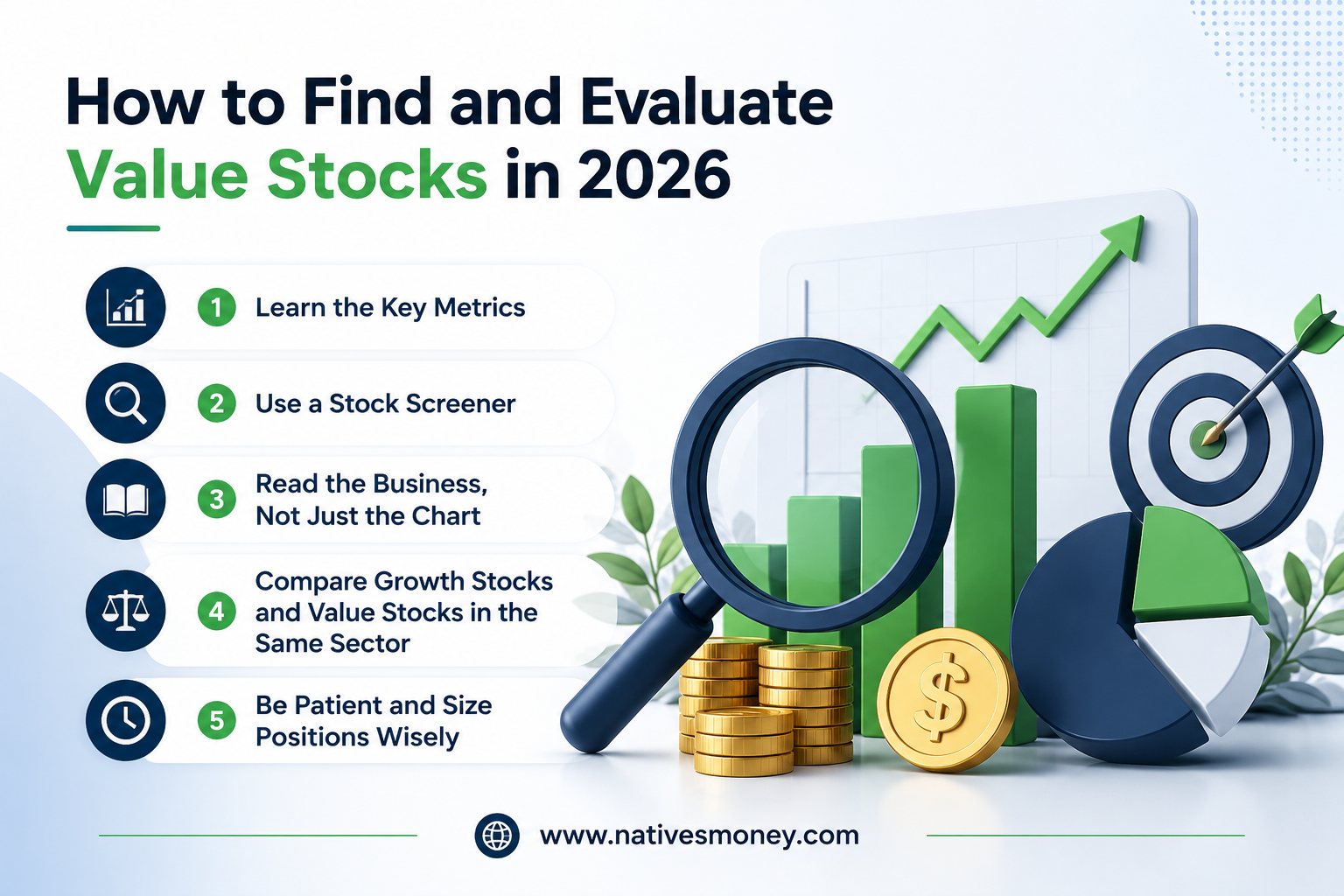
Step 1: Learn the Key Metrics
You don’t need a finance degree , but you do need to understand a few key numbers. Here’s what I look at when comparing opportunities in the growth vs value stocks market debate:
Price-to-Earnings (P/E) Ratio , This compares a company’s stock price to its earnings per share. A low P/E relative to industry peers can signal undervaluation. The S&P 500’s average P/E historically sits around 15–20. A company at 8–10 in the same sector might be worth a closer look.
Price-to-Book (P/B) Ratio , This compares stock price to the company’s book value (assets minus liabilities). A P/B below 1.0 means you’re buying the stock for less than the company’s net assets are worth. That’s a classic value signal.
Dividend Yield , Many established companies pay dividends. A healthy, consistent dividend is often a sign that the business generates real cash flow, not just accounting profits. This is one reason why the growth vs value stocks debate remains so important among long-term investors.
Step 2: Use a Stock Screener
You don’t need to manually dig through hundreds of companies. Free tools like Finviz.com, Zak, and the screeners built into Fidelity and Charles Schwab let you filter stocks by P/E, P/B, dividend yield, sector, and more.
I usually start with Finviz , set P/E below 15, P/B below 1.5, and dividend yield above 2%. That gives me a starting list to dig into further. It’s not a buy signal on its own, but it narrows the field fast.
Step 3: Read the Business, Not Just the Chart
This is where most beginners skip a step. A low P/E ratio is meaningless if the company is in structural decline. Blockbuster had a “low valuation” right up until it didn’t have a business anymore.
Read the company’s last two or three annual reports (10-K filings on SEC.gov are free). Ask: Is revenue growing or shrinking? Is debt manageable? Does the company generate consistent free cash flow? Is management buying their own stock?
Step 4: Compare Growth Stocks and Value Stocks in the Same Sector
When I’m evaluating a potential value pick, I always compare it to the growth stocks in the same sector. If a bank stock trades at 8x earnings while the sector average is 12x, that gap is worth understanding. Sometimes it’s justified , the company has real problems. Sometimes it’s temporary , bad news cycle, short-term earnings miss, sector-wide selloff.
The gap between price and value is where opportunity lives. But you need to understand why the gap exists before you invest.
Step 5: Be Patient and Size Positions Wisely
Value investing is not a quick flip strategy. Some of the best value opportunities take 12–36 months to play out as the market corrects its mispricing. I never put more than 5–10% of my portfolio in any single value stock , no matter how convinced I am. Concentration risk is real, even when your thesis is right.
Mistakes I Made Hunting for Value Stocks
Confusing “cheap” with “undervalued.” A stock can be cheap for very good reasons , a dying business model, deteriorating financials, a CEO under investigation. I bought a retail stock once because the P/E looked amazing. The company filed for bankruptcy 18 months later. Low price is not the same as good value.
Ignoring the macro environment. Certain sectors , like regional banks or energy , are highly sensitive to interest rates, oil prices, and regulatory changes. I didn’t account for this early on and watched some “great investment picks” get crushed by macro headwinds that had nothing to do with the company itself. That’s also why so many investors constantly ask, what is the best stock to invest in right now, especially during uncertain economic conditions.
Selling too early. Value investing requires conviction and patience. I’ve sold solid positions after a 15% gain only to watch them run another 60% over the next two years. If your thesis hasn’t changed, a rising price is confirmation , not a reason to exit.
Skipping the debt check. A company can look cheap on earnings while carrying a debt load that could sink it in a downturn. Always check the debt-to-equity ratio and interest coverage before committing.
What to Realistically Expect from Value Investing
They tend to underperform growth stocks during bull markets and outperform during corrections and bear markets. That’s a consistent historical pattern , and it’s exactly why this type of investing requires a longer time horizon.
If you’re asking what is the best stock to invest in right now, the honest answer is: it depends on your timeline. Value stocks aren’t lottery tickets. They’re more like carefully selected real estate , chosen for their fundamentals, held patiently, and sold when the gap between price and value closes.
Historically, this category of investments has delivered returns in the range of 8–12% annually over long periods , comparable to broad market returns, but with different risk characteristics. You’re trading some of the upside volatility for more downside protection.
One US tax note: if you hold investments for more than 12 months before selling, your gains qualify for long-term capital gains tax rates (0%, 15%, or 20% depending on income) , far more favorable than short-term rates. Patience often pays twice in long-term investing.
Best Tools for Finding Value Stocks in 2026
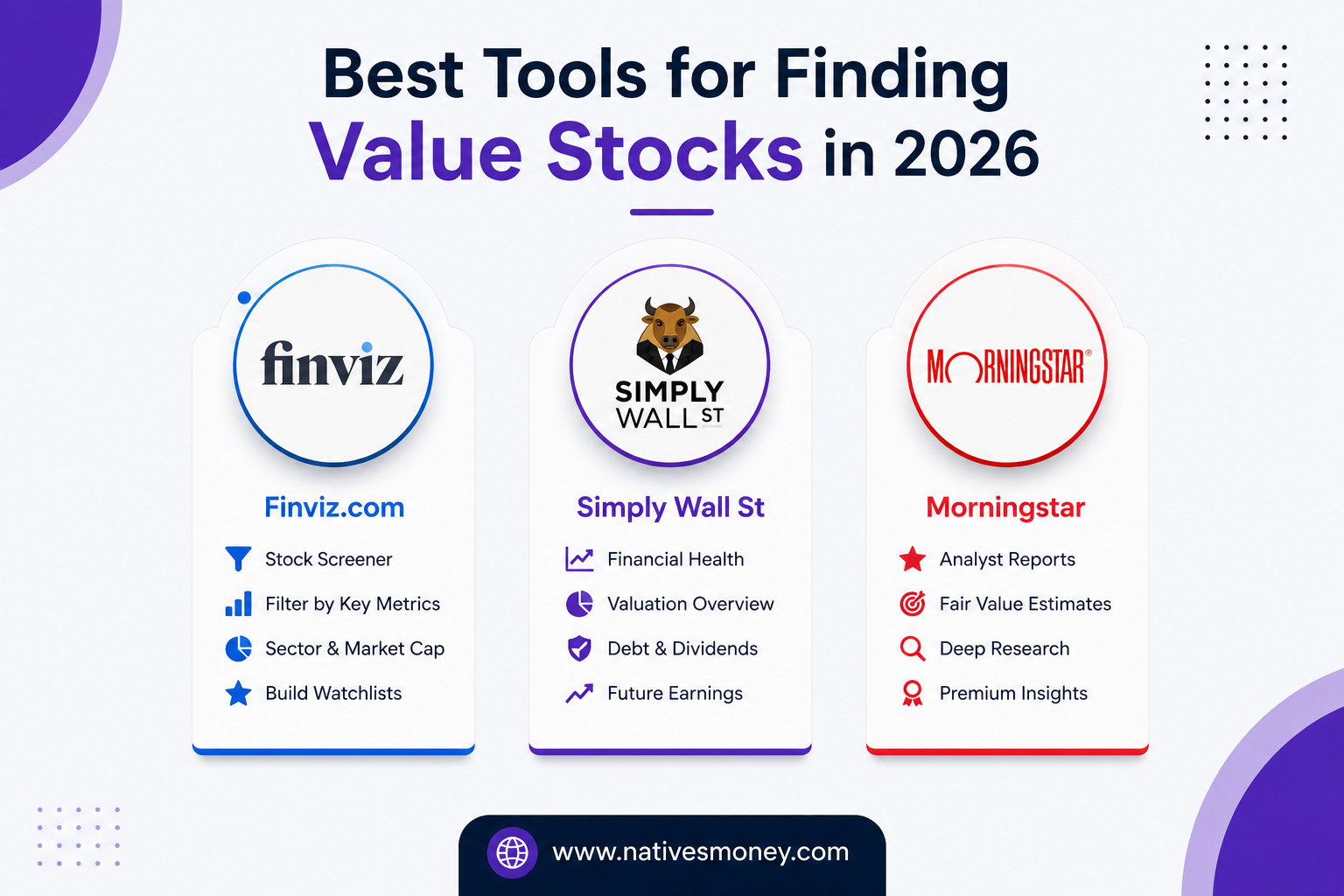
Finviz.com , My go-to free stock screener. Fast, powerful, and free. You can filter by P/E, P/B, dividend yield, sector, market cap, and dozens of other metrics. Perfect for building an initial watchlist.
Simply Wall St , A paid tool (free tier available) that visualizes a company’s financial health in plain language. Great for beginners who find 10-K filings overwhelming. It breaks down valuation, debt, dividends, and future earnings in simple charts.
Morningstar , The gold standard for fundamental stock research in the US. Their analyst reports include a “fair value” estimate for thousands of stocks, which makes value comparison straightforward. Their premium plan is worth it for serious investors.
For a solid foundation on where value stocks fit into your broader portfolio, the beginner’s guide to how to start investing on Natives Money is a great starting point. And when you’re ready to think beyond individual stocks, check out these 15 smart investment strategies for long-term wealth and the ultimate guide to passive income investments for the bigger picture.
The Bottom Line
Value stocks offer one of the most proven, time-tested paths to building wealth , not through luck or timing, but through disciplined analysis and patience. You’re looking for solid businesses that the market has temporarily mispriced, buying in before the crowd catches on, and holding until the gap closes.
Explore more practical investing guides at nativesmoney.com , built for real people who want to grow real wealth.