

The first time someone asked me what is index fund, I nodded like I knew the answer. I didn’t. I had been “investing” for almost a year at that point , buying random stocks based on what I saw trending online , and I had never once looked into the most basic, most powerful investment vehicle available to everyday Americans.
That was a mistake. The answer to index fund investing changed how I think about money. Not just because index funds outperform most actively managed strategies over the long run. But because I wasted months of compounding returns chasing individual stocks when a simpler, smarter approach was sitting right in front of me.
If you’re asking what is index fund investing is for the first time , or the tenth , you’re in the right place. This guide explains exactly what it is, why it works, how to invest in an index fund from scratch, and what mistakes to avoid. No jargon, no fluff, just the real picture.
What Is Index Fund Investing, Really?
An index fund is a type of investment fund that tracks a specific market index , like the S&P 500, the Nasdaq 100, or the total US stock market. Instead of a fund manager picking individual stocks, the fund simply buys every stock in that index automatically.
What Is Index Fund? At its core, it’s like ordering a sampler platter at a restaurant instead of choosing just one dish. You get a small portion of everything on the menu. That’s what an index fund is: instant, automatic diversification. If one company performs poorly, others can help balance it out. That’s the power of diversification, and it’s exactly what an index fund provides.
Here’s a simple example. The S&P 500 index tracks the 500 largest US companies , Apple, Microsoft, Amazon, Google, and hundreds more. When you buy an S&P 500 index fund, you own a tiny slice of all 500 companies at once. When the US economy grows, your investment grows with it.
Understanding what is a index fund investing is the first step toward building a real investment strategy , one that doesn’t require you to pick winners or guess the market.
What is Index Fund? How Index Funds Work: The Key Concepts
Before you invest a single dollar, ask yourself what is a index fund structure actually like. Here are the key things you need to understand.
Most mutual funds are actively managed , a team of professional investors picks stocks and tries to beat the market. When people think about mutual funds vs stocks, they often forget that index funds are a third, often better option. That sounds great in theory. In practice, studies consistently show that over 80–90% of actively managed funds underperform their benchmark index over a 20-year period.
Index funds are passively managed. No one is picking stocks. The fund just mirrors the index. That simplicity is what makes it powerful. This concept is really explained by comparing mutual funds vs stocks, showing active vs passive approaches, and index funds win on cost nearly every time.
What is Index Fund? Expense Ratios and How Index Funds Work
Every fund charges a fee called an expense ratio. For actively managed mutual funds, this can run 0.5–1.5% per year. For index funds, it’s often as low as 0.03–0.10%. That difference compounds into thousands of dollars over a 30-year investment horizon. Lower fees mean more of your money stays invested and keeps growing.
How Returns Work
When companies in the index pay dividends, index fund holders receive those dividends proportionally. When stock prices rise, the fund’s value rises too. And when prices drop, the fund drops. You’re riding the broad market , not betting on individual companies.
This is one of the different types of investments that genuinely rewards patience. And it answers what is index fund value is in one word: time. The longer you hold, the more time compound growth has to work in your favor.
What is Index Fund? Step-by-Step Guide on How to Invest in Index Funds
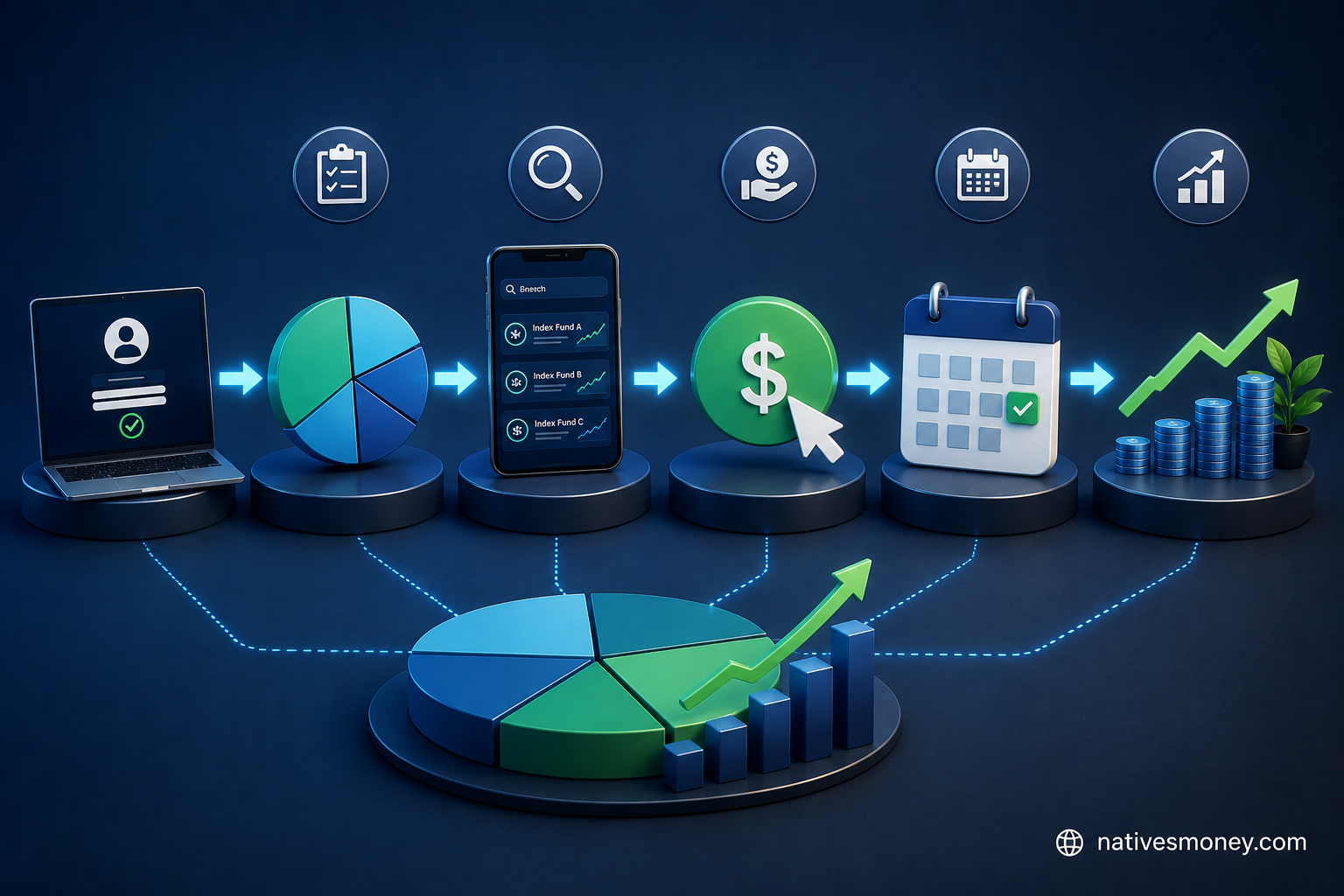
Step 1: Choose Your Account Type
When learning what is index fund investing, it’s important to choose the right account before picking a fund. A Roth IRA lets your index fund grow completely tax-free—you contribute after-tax dollars and pay zero taxes on qualified withdrawals in retirement. A traditional 401(k) grows tax-deferred, while a regular brokerage account may be subject to capital gains taxes. Understanding the tax treatment of each account type can help you make a smarter investing decision.
For most beginners, the Roth IRA is the best starting point. The 2026 contribution limit is $7,000 per year. Max it out before investing in a taxable account.
Step 2: Pick a Brokerage
If you’re researching what is index fund investing and where to get started, you can open an account at Fidelity, Vanguard, or Charles Schwab. All three are excellent U.S.-based platforms with no account minimums and zero trading fees on many index funds. Fidelity offers zero-expense-ratio funds such as FZROX, while Vanguard is widely regarded as the pioneer and gold standard of long-term index fund investing.
Step 3: Choose Your Index Fund
This is where most beginners overthink it. You don’t need a perfect fund , you need a broadly diversified, low-cost one. Here are the most popular options for US investors:
- If you’re still asking what is a index fund worth buying, here are the most popular options:
- VTI (Vanguard Total Stock Market ETF) , covers the entire US market
- FZROX (Fidelity Zero Total Market Index Fund) , zero expense ratio
- SPY or VOO , tracks the S&P 500
Learning index fund selection really comes down to this: pick a low-cost total market or S&P 500 fund and hold it for decades. That’s the core strategy.
Step 4: Set Up Automatic Contributions
Once you understand what is index fund investing, the most powerful thing you can do is automate your contributions. Set a fixed amount to transfer from your checking account to your investment account every month—ideally on payday, before you have a chance to spend it. This simple habit can help you build wealth consistently over time.
Consistent monthly investing, regardless of what the market is doing, is called dollar-cost averaging. This approach is at the heart of an index fund strategy for long-term investors. You buy more shares when prices are low and fewer when they’re high. Over time, this smooths your average cost and removes emotion from the equation entirely.
Step 5: Leave It Alone
Once you understand what is index fund investing, the hardest step is often staying patient. Index fund investing rewards consistency, not constant activity. Check your balance quarterly, not daily. Don’t sell when the market drops 20%, and don’t try to time your way in and out. Stay invested, keep contributing, and let compounding do the heavy lifting over time.
Waiting for the “right time” to invest. There is no perfect entry point. I spent three months waiting for the market to dip before investing , and it went up the whole time. Time in the market beats timing the market. Start now, even with $50.
Choosing a fund with high fees. Not all index funds are cheap. Some marketed as “index funds” still charge 0.5%+ in fees. Always check the expense ratio before buying. Anything over 0.20% for a broad market fund is too high.
Confusing index funds with actively managed mutual funds. This is one of the most common misunderstandings I see. The mutual funds vs stocks comparison often leaves out index funds entirely , but they’re fundamentally different from both. What is index fund design? It’s passive, low-cost, and diversified by nature. A mutual fund may be none of those things.
Selling during a correction. Every time the market drops significantly, new investors panic. I watched my portfolio fall 25% in 2022 and felt the urge to sell everything. I didn’t , and I recovered fully and then some. Selling during a downturn locks in losses permanently.
What is Index Fund? A Realistic Guide to What to Expect From Index Fund Investing

Let me give you honest numbers. The S&P 500 has returned an average of about 10% per year historically , roughly 7% after adjusting for inflation. That’s not guaranteed, but it’s the benchmark most long-term investors use.
Here’s what consistent investing looks like in practice:
- $200/month for 10 years at 7%: ~$34,000 (contributed $24,000)
- $200/month for 20 years at 7%: ~$104,000 (contributed $48,000)
- And $200/month for 30 years at 7%: ~$227,000 (contributed $72,000)
In the 30-year scenario, you put in $72,000 and ended up with $227,000. Over $150,000 came from compound growth , not from your own pocket.
One important US-specific note: inside a Roth IRA, all of that growth is completely tax-free. That alone makes the Roth IRA and index fund combination one of the most powerful wealth-building tools available to Americans.
Best Platforms to Start Investing in Index Funds
Fidelity , My top pick for beginners. No minimums, no trading fees, and their FZROX fund charges literally zero in annual fees. Their app is clean and easy to navigate, and their educational resources are excellent.
Vanguard , The original home of index fund investing. Lower costs than almost any other platform. Best for long-term, buy-and-hold investors who want the institutional approach.
M1 Finance , A great middle option for people who want to automate a custom portfolio of index funds. It handles rebalancing automatically and has no trading fees.
Once you understand what is index fund investing and you’re ready to put your money to work, I’d recommend reading the ultimate guide to passive income investments for financial freedom as your next step. Then check out long-term investment strategies for 2026 and the 7 types of investments for beginners to see how index funds fit into a full investment plan.
The Bottom Line
Explore more practical, no-fluff investing guides at nativesmoney.com , real strategies for real people building real wealth.
FAQ
What is index fund investing in simple terms?
What is index fund vs a mutual fund?
How do I start learning how to invest in an index fund?
If you’re learning what is index fund investing and how to get started, open a Roth IRA or brokerage account at Fidelity, Vanguard, or Schwab. Then choose a broad, low-cost fund such as VTI or FZROX. Set up automatic monthly contributions and avoid making frequent changes. That’s really all it takes to begin investing in index funds as a beginner. Start small, stay consistent, and let compound growth work for you over time.
What are the different types of investments compared to index funds?
How much money do I need to start investing in index funds?
Very little. Fidelity’s FZROX has a $0 minimum. Vanguard’s ETFs start at one share price (usually $100–$200). Moreover, many brokerages also offer fractional shares for as little as $1.
Therefore, understanding what index fund investing is step one; however, taking action with whatever you have available right now is step two. In fact, you don’t need to wait until you have a lot of money to start.