

A few years ago, I was stuck in a job I didn’t love and desperately searching for business ideas to start on the side. I had maybe $500 to spare — no investors, no safety net, no business degree. I just had a laptop, Wi-Fi, and a strong desire to build something of my own.
Most guides I found at the time were either too vague or required serious upfront capital. But here’s what I eventually learned: the best business ideas to start in 2026 don’t require much money at all. They require the right information, consistent action, and a willingness to start before you feel ready.
In this guide, I’ll share some of the best low-investment business opportunities available today. I’ll also walk you through how to get going, what mistakes to avoid, and what realistic results look like. Let’s get into it.
Why Low-Investment Business Ideas to Start Are the Smart Move
 When exploring business ideas to start, it’s important to understand that the old model of starting a business meant renting a space, buying inventory, and hiring staff before you made a single dollar. That model still exists, but it carries significant risk. Most small businesses fail because they run out of cash, not because the idea itself was bad.
Flip the model: you validate first, test your offer with minimal spending, and then scale what actually works. This approach is especially powerful for online business ideas, where startup costs can be as low as a domain name and a free website builder.
When people ask me how to start an online business, I always say the same thing: pick one idea, set it up simply, and get your first customer before you spend a dollar on branding or ads. That first paying customer teaches you more than any course ever will.
The beauty of starting online is also the flexibility. You can test multiple ideas at low cost, pivot quickly, and build income streams that work around your existing schedule. That’s a huge advantage for anyone in their 20s or 30s with a full-time job or family commitments.
Top Low-Investment Business Ideas to Start in 2026
1. Freelance Services
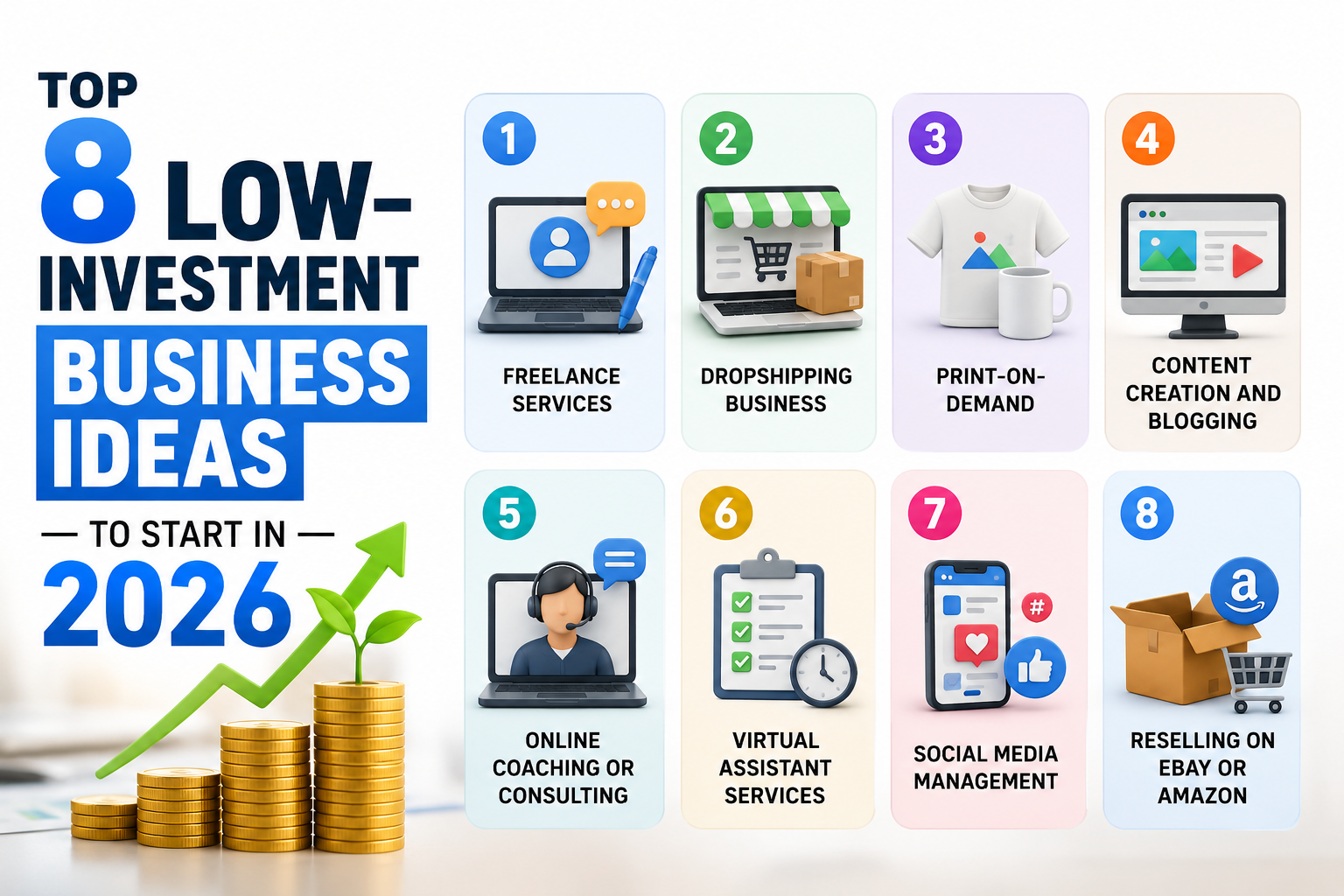
Freelancing is one of the fastest business ideas to start with zero upfront cost. If you can write, design, do bookkeeping, edit video, manage social media, or code — someone will pay you for it. Platforms like Upwork, Fiverr, and Toptal connect US freelancers with clients worldwide. I started with freelance writing and earned my first $200 within two weeks of creating a profile.
2. Dropshipping Business Ideas to Start
Dropshipping lets you sell products online without holding any inventory. When a customer buys from your store, the supplier ships directly to them. It’s one of the most popular online business ideas right now because the startup cost is low — you mainly pay for your Shopify store ($29/month) and marketing. The tricky part is finding winning products, but tools like AutoDS and Zendrop make that much easier.
3. Print-on-Demand
Print-on-demand works like dropshipping but for custom-designed products — T-shirts, mugs, phone cases, and more. You upload designs, set your prices, and Printful or Printify handles production and shipping. You never touch the product. It’s a solid low-risk option for creative people who want to sell without managing logistics.
4. Content Creation and Blogging
Starting a niche blog or YouTube channel is one of the best long-game business ideas to start with almost no money. A domain costs around $12/year. Hosting is $3–$5/month. Once you build an audience, you can earn through ads, affiliate marketing, and sponsored posts. It takes 12–18 months to see real income, but the upside is significant — and it compounds over time.
5. Online Coaching or Consulting
Do you have expertise in fitness, finance, marketing, career development, or any other skill? You can turn that into a coaching business. Knowing how to start a online business as a coach is simpler than most people think: a Calendly link, a Stripe account to collect payment, and a free Zoom account to host calls. Many coaches start at $75–$150/hour. Some scale to six figures within a year.
6. Virtual Assistant Services Business Ideas to Start
Businesses of all sizes need help with email management, scheduling, research, data entry, and customer support. Virtual assistants (VAs) fill that gap remotely. Getting started requires nothing but strong organizational skills and a computer. Rates range from $15–$50/hour depending on the tasks involved. It’s one of the quickest ways to earn money while building business experience.
7. Social Media Management
Small businesses need help managing their Instagram, Facebook, and TikTok accounts — but many owners don’t have the time or skills. If you understand how social platforms work, this is a great business ideas to start with one or two local clients. Charge $300–$800/month per client. Once you have three to five clients, you have a real business.
8. Reselling on eBay or Amazon
Retail arbitrage — buying discounted products and reselling them at a profit — is a surprisingly accessible business. Start at thrift stores, clearance aisles, or liquidation sites like BULQ. List items on eBay or Amazon FBA. You can start with $100–$200 in inventory and test the model before scaling up.
Mistakes Beginners Make When Starting a Low-Investment Business
I’ve made most of these myself. Learning from them saved me a lot of wasted time and money.
- Trying to do everything at once. One of the biggest mistakes people make when testing business ideas to start is trying too many things at once. I launched a dropshipping store, started a blog, and tried freelancing all in the same month. I succeeded at none of them. Pick one idea and go all in for at least 90 days before adding anything else.
- Overbuilding before getting a customer. A lot of new entrepreneurs spend weeks building a perfect website before they have a single sale. That’s backwards. When you figure out how to start online business, the goal is a paying customer as fast as possible — then build the rest around demand.
- Skipping the legal basics. Even a small side business should register as an LLC to separate personal and business liability. In the US, LLC registration typically costs $50–$150 depending on your state. Also open a separate business bank account. These steps protect you and look professional to clients.
- Ignoring taxes. Self-employment income in the US is taxable. You’ll owe self-employment tax (15.3%) plus income tax on profits. Set aside 25–30% of every payment from day one. Use tools like QuickBooks Self-Employed or Wave to track income and expenses automatically.
What to Realistically Expect From Your New Business
 Here’s the honest truth about business ideas to start with low investment: the early months are usually slow. Most people don’t earn meaningful income in the first 30–60 days, and that’s completely normal. The key is to stay consistent and treat it like a real business, not a lottery ticket.
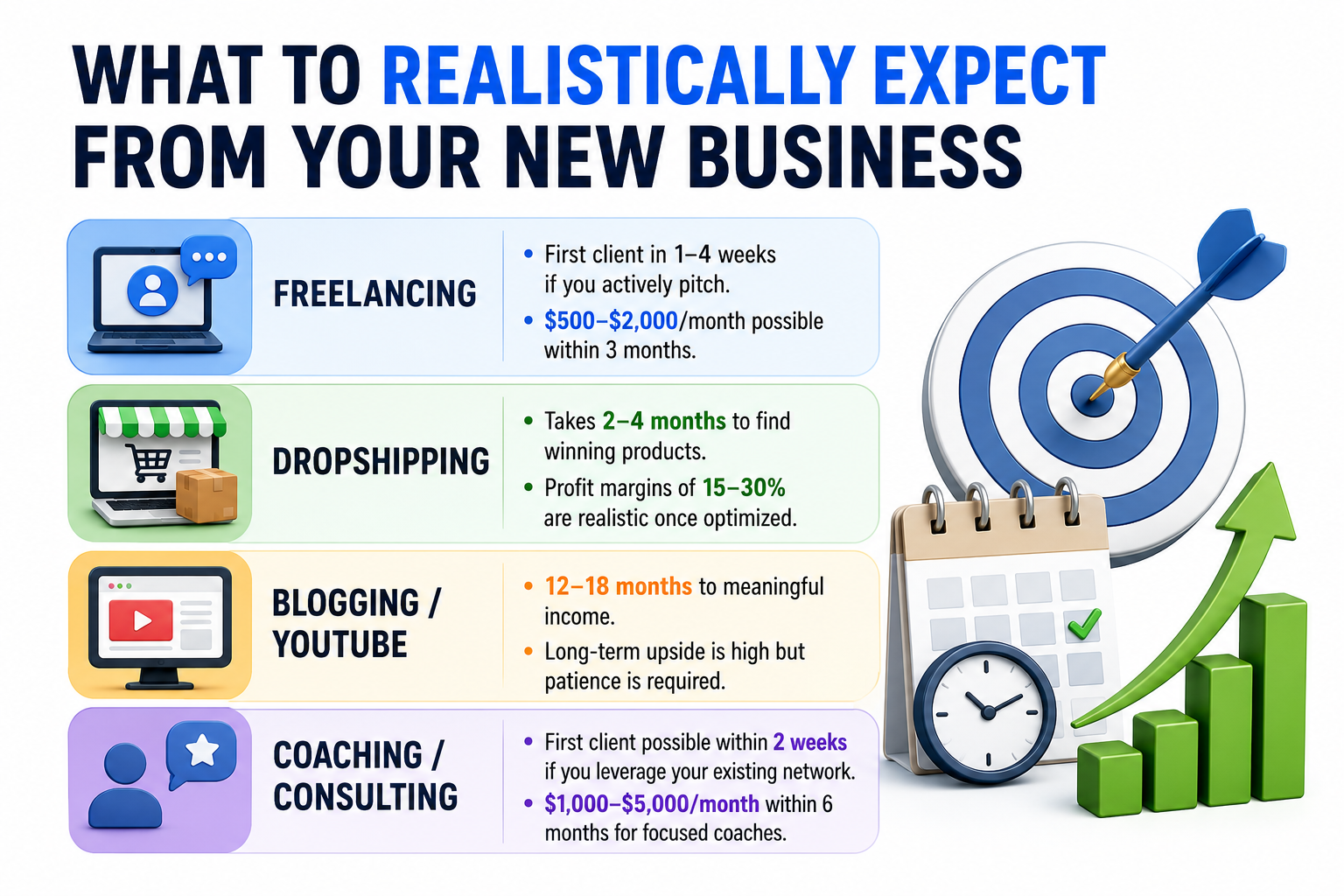
- Freelancing: First client in 1–4 weeks if you actively pitch. $500–$2,000/month possible within 3 months.
- Dropshipping: Takes 2–4 months to find winning products. Profit margins of 15–30% are realistic once optimized.
- Blogging/YouTube: 12–18 months to meaningful income. Long-term upside is high but patience is required.
- Coaching/consulting: First client possible within 2 weeks if you leverage your existing network. $1,000–$5,000/month within 6 months for focused coaches.
Understanding how to start a online business also means understanding that your income will be inconsistent at first. Build an emergency fund before you go full-time. Keep your day job while the business grows. Most successful entrepreneurs I know ran their business on the side for 1–2 years before making it their primary income.
Also, once your business generates consistent income, consider putting some of those profits to work through smart investing. Check out the ultimate guide to passive income investments for financial freedom in 2026 to see how business owners build long-term wealth alongside their active income.
Best Tools to Launch Your Business Ideas to Start in 2026
Shopify for Business Ideas to Start
For any product-based online business ideas — dropshipping, print-on-demand, or your own products — Shopify is the most beginner-friendly platform in the US. It handles payments, inventory tracking, and integrates with dozens of apps. Plans start at $29/month. The 3-day free trial lets you build your store before committing.
Canva for Business Ideas to Start
Canva is a free design tool that covers almost every creative need a new business owner has — social media graphics, logos, pitch decks, and more. You don’t need a designer. The free plan is genuinely powerful, and the Pro plan ($13/month) unlocks a huge library of templates and brand kit tools.
Stripe + Calendly (for service businesses)
If your business ideas to start involve selling services—such as coaching, consulting, virtual assistant work, or social media management—you’ll need a way to get booked and paid. Tools like Calendly can handle scheduling with a free plan, while Stripe manages payments for a small transaction fee. Together, they create a simple, professional setup that you can configure in under an hour.
For more on building lasting income from your business efforts, read long-term investments: best strategies to build wealth in 2026. And if you want to understand the full investing picture as your business income grows, 7 types of investments for beginners to build wealth in 2026 is a great next step.
Start Your Business Today — Not Someday
The best business ideas to start are the ones you actually launch. Low investment doesn’t mean low potential — some of the most profitable online businesses were started with less than $100. What matters most is choosing one idea, committing to it, and taking action before you feel perfectly ready.
Pick one business idea to start from this list, take one concrete step today — register a domain, create a profile, or reach out to your first potential client — and keep building from there. Your future self will thank you. For more real-world guidance on growing your income and wealth, explore everything at nativesmoney.com.
Frequently Asked Questions
What are the best business ideas to start with little money?
The best low-investment business ideas to start include freelancing, dropshipping, print-on-demand, content creation, online coaching, virtual assistant services, and social media management. All of these require minimal upfront costs — most can be launched for under $100 — and each can scale into a full-time income with consistent effort.
How do I know which business ideas to start are right for me?
Start with your existing skills and interests. If you’re a good writer, start freelancing or blogging. If you enjoy design, explore print-on-demand. And if you love fitness, try online coaching. The business you understand best is the one you’ll stick with through the slow early months — and that persistence is what actually determines success.
How to start an online business as a complete beginner?
Knowing how to start an online business comes down to four steps: pick one idea, set up the minimum viable version (a profile, a simple website, or a product listing), find your first customer through your existing network or free platforms, and then iterate based on feedback. Don’t over-build before you have paying customers.
How to start a online business without quitting your day job?
Learning how to start a online business while employed is the smartest approach. Dedicate 1–2 hours each evening or weekend morning to your new venture. Keep your day job income stable while the business grows. Most successful online business owners ran their side hustle for 12–24 months before transitioning full-time.
How to start online business legally in the US?
To how to start online business the right way legally: register an LLC in your state ($50–$150 depending on state), get an EIN (free from the IRS), open a separate business bank account, and keep records of all income and expenses. Use accounting software like Wave (free) or QuickBooks Self-Employed ($15/month) from day one to stay tax-ready.