
I still remember the first business plan I ever wrote. It was 14 pages long, packed with charts nobody asked for, and I spent three weekends on it. When I finally handed it to a mentor I trusted, he skimmed the first paragraph, looked up, and asked, “Can you tell me what this business actually does in three sentences?” I couldn’t. That moment taught me more about planning than any course ever did, and it’s exactly why I eventually switched to writing a one page business plan for every idea I’ve started since.
If you’re staring at a blank document right now, overwhelmed by templates that ask for twenty sections you don’t understand, I get it. You don’t need forty pages to prove your idea is worth pursuing. You need clarity, and clarity fits on one page far more often than people think. In this guide, I’ll walk you through exactly how I build a one page business plan from scratch, show you real business plan examples, and give you a simple executive summary template you can copy today.
By the end of this article, you’ll know how to turn a messy idea into a tight, convincing startup plan that you can actually use , to pitch investors, guide your own decisions, or just prove to yourself that the idea holds up.
What Is a One Page Business Plan, Really?

A one page business plan is a single-page document that captures the core of your business: what you’re selling, who you’re selling it to, how you’ll make money, and why you’re positioned to win. Think of it as the elevator pitch version of a full business plan, minus the fluff that nobody outside a business school actually reads.
I’ve written both types. A traditional business plan can run 20 to 40 pages and takes weeks to finish. A one page business plan takes me an afternoon, and it forces a kind of discipline that longer documents let you avoid. When you only have one page, you can’t hide behind vague language or filler paragraphs. Every sentence has to earn its place, and that pressure alone usually reveals whether your idea is actually solid.
This format works because most people reading your plan , investors, partners, even your future self , don’t want the whole story upfront. They want to know quickly whether it’s worth their time to ask you more questions. A well-built one page business plan does that job in under two minutes.
How I Structure a One Page Business Plan (Step by Step)

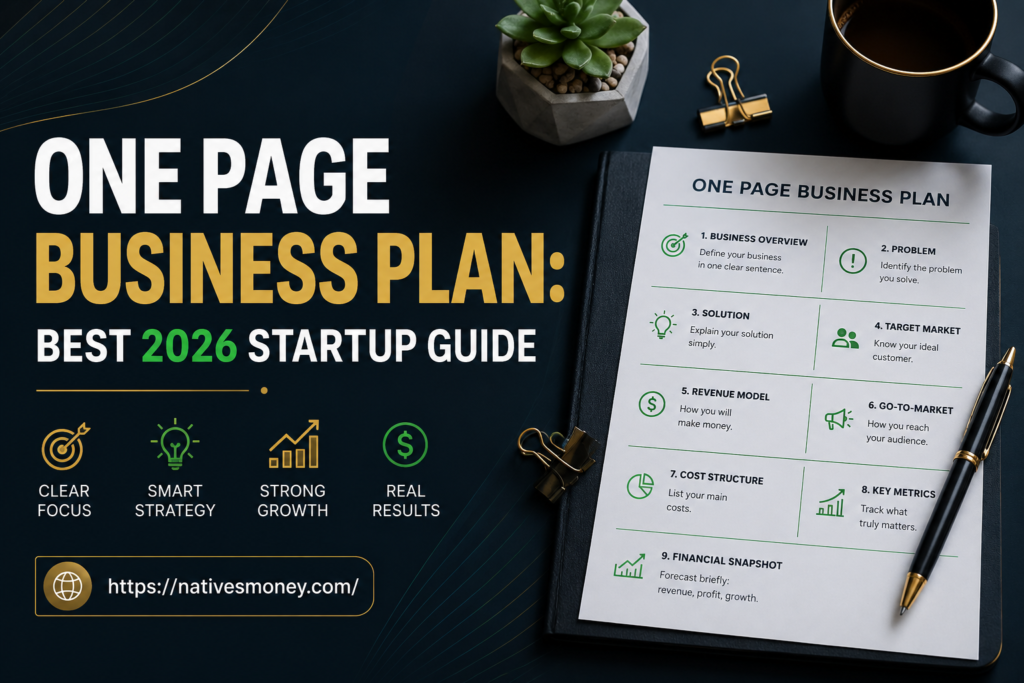
Here’s the exact structure I use every time I sit down to write a one page business plan. I’ve tested longer versions and shorter versions, and this six-part layout consistently works best for American investors and lenders who are used to skimming.
1. Executive Summary
This sits at the top of the page and it’s the part most people rush, which is a mistake. This opening section should be two to three sentences that explain what your business does, who it serves, and what makes it different. I always write this section last, even though it appears first, because it’s easier to summarize a plan once the rest of it already exists.
If you’re stuck, here’s a simple executive summary template I use with clients:
“[Business name] helps [target customer] solve [specific problem] by offering [product or service]. Unlike [main competitor or alternative], we [unique advantage], and we plan to generate revenue through [revenue model].”
Fill in those blanks honestly and you’ll have a working executive summary template in under ten minutes.
2. The Problem and Your Solution
State the problem your customer faces in one or two sentences, then explain your solution just as briefly. I made the mistake early on of describing my solution before I clearly named the problem, and investors kept asking “wait, what issue are you actually solving?” Lead with the pain point every time.
3. Target Market
Who exactly is buying this? Not “everyone” , that answer kills credibility faster than anything else on the page. Get specific: age range, income level, location, behavior. When I nailed down my target market for one of my earlier side projects, my marketing costs dropped almost immediately because I stopped wasting money on the wrong audience.
4. Revenue Model
Explain, in plain language, how the business makes money. Subscription, one-time sales, commission, advertising , whatever it is, spell it out in a sentence or two. This is one of the sections people skip when they rush the process, and it’s usually the first thing an investor asks about if it’s missing.
5. Competitive Advantage
What do you have that competitors don’t? This doesn’t need to be a groundbreaking invention. Sometimes it’s better customer service, faster delivery, or a niche nobody else is serving well. Be honest here , vague claims like “we’re just better” don’t hold up under questions.
6. Milestones and Financial Snapshot
Close the page with a short list of what you’ve already accomplished and what’s coming next , first sale, first hire, break-even point, funding goal. A few real numbers, even rough ones, make your plan feel grounded instead of theoretical.
Business Plan Examples That Actually Work

Reading business plan examples helped me more than any advice article when I was starting out, so here are two simplified versions based on real businesses I’ve helped plan for:
Example 1 , Local Coffee Roaster: Summary: “Brew & Bean supplies small cafes in Austin with locally roasted, ethically sourced coffee beans, delivered within 24 hours of roasting. Unlike national distributors, we offer same-week custom blends at competitive wholesale pricing.” Target market: Independent coffee shops within 50 miles of Austin, Texas. Revenue model: Wholesale bean sales plus a monthly subscription box for smaller cafes.
Example 2 , Freelance Bookkeeping Service: Summary: “LedgerLine provides monthly bookkeeping for solo entrepreneurs and small e-commerce sellers who can’t afford a full-time accountant. Unlike generic bookkeeping software, we pair every client with a real person who reviews their books by hand.” Target market: Solo entrepreneurs earning $50,000–$250,000 annually with no in-house accounting. Revenue model: Flat monthly retainer, tiered by transaction volume.
Both of these business plan examples fit comfortably on one page, and both were built using the exact six-part structure above.
One-Page Business Plan vs. Full Business Plan vs. Executive Summary
People confuse these three documents constantly, so here’s a comparison table I put together to make the differences obvious at a glance.
| Feature | One Page Business Plan | Executive Summary | Full Business Plan |
|---|---|---|---|
| Typical length | 1 page | Half a page to 1 page | 15–40 pages |
| Time to write | 1–3 hours | 30–60 minutes | Several weeks |
| Best used for | Internal clarity, quick pitches, early validation | Attachment to a full plan or loan application | Bank loans, SBA funding, VC due diligence |
| Level of financial detail | Basic snapshot | Minimal to none | Full projections, statements |
| Audience | Founders, early advisors, casual investors | Readers who need a fast overview before diving deeper | Lenders, serious investors, boards |
| Update frequency | Monthly or as things change | Rewritten each time the full plan changes | Reviewed quarterly or annually |
Notice that this short opening isn’t actually a replacement for a one page business plan , it’s a piece of it. A full plan for a startup business almost always begins with that short opening statement, but a one page business plan condenses the entire document, not just the introduction.
Mistakes I See Beginners Make With Their One Page Business Plan
I’ve reviewed dozens of these documents for people in my network, and the same problems show up again and again.
Trying to cram in everything. The point of a one page business plan is restraint. If you’re shrinking the font to size 8 to fit more text, you’ve missed the exercise entirely. Cut instead of shrinking.
Skipping the numbers. Even a rough estimate of costs, pricing, and expected revenue is better than nothing. I once submitted a plan with zero numbers, and the first question I got back was simply, “so how does this make money?”
Writing it once and never touching it again. Your one page business plan should evolve as your business does. I update mine every time I learn something that changes my assumptions about the market or the model.
Being vague about the target market. “Anyone who needs [product]” is not a target market , it’s an admission that you haven’t done the research yet.
What to Realistically Expect From a One Page Business Plan
It won’t replace a full financial model, and it won’t guarantee funding on its own. What it will do is force you to think clearly, give you a document you can actually hand someone in a hallway conversation, and act as the foundation you expand into a full plan for a startup business later, if and when you need one.
In my experience, most early-stage investors and small business lenders in the US appreciate receiving a one page business plan alongside a fuller document, not instead of one. The SBA, for example, often points founders toward a lean-format plan as a starting point before they build out the detailed version required for loan applications. Treat your one page business plan as the compass, not the whole map.
When You Actually Need a One Page Business Plan
Not every situation calls for the same version of this document, and figuring that out early saves you a lot of rewriting later. Over the years I’ve used a one page business plan in three very different situations, and each one shaped the plan slightly differently.
Before you build anything. When an idea is still just a notion in your head, writing a one page business plan is the fastest way to pressure-test it. If you can’t fill out the six sections convincingly, that’s useful information , it usually means you need to research your target market more before you spend money on inventory, a website, or an LLC filing.
When you’re pitching casually. Not every investor conversation happens in a formal boardroom. Plenty of my early funding came from conversations at coffee shops and local meetups, and having a one page business plan ready on my phone meant I could share something concrete the moment someone asked “so what exactly are you building?”
When you’re applying for small funding or a microloan. Community lenders and local economic development programs in the US often ask for a shorter planning document before they’ll even schedule a full loan meeting. A clean one page business plan signals that you’ve thought things through without asking a loan officer to read forty pages before your first conversation.
In each of these cases, the underlying document barely changes , what changes is how much supporting detail you attach behind it. I usually keep a folder of backup data (market research, competitor notes, cost breakdowns) ready to send if someone wants more than the one page business plan itself.
Tools and Resources I Actually Use

A few tools make building and formatting a one page business plan much faster:
- Canva or Google Docs , either works fine for laying out a clean, one-page document with simple formatting. You don’t need design software to make this look professional.
- LivePlan , useful if you want to eventually expand your one page business plan into a full financial model without starting from scratch.
- SCORE mentors (free, through the SBA) , a free mentor reviewed my first plan for a startup business and caught two assumptions I hadn’t questioned. I’d recommend this to anyone starting out.
If you want more guidance on building the earlier stages of your business before you even get to the planning document, check out our entrepreneurship section on Natives Money for more real-world breakdowns.
A Quick Checklist Before You Hit Send
Before I share any planning document with an investor, a lender, or even a friend I trust for feedback, I run through this short checklist. It’s saved me from embarrassing gaps more than once.
- Does it explain the problem before the solution? If someone unfamiliar with your idea can’t tell what pain point you’re solving within the first two sentences, rework the opening.
- Is the target market specific? “Small business owners” is too broad. “Independent hair salon owners with 1–3 employees in mid-sized US cities” is specific enough to act on.
- Are there real numbers, even rough ones? Pricing, expected costs, and a rough break-even timeline all belong on the page, even as estimates.
- Would a stranger understand it in two minutes? Hand it to someone outside your industry. If they’re confused, simplify the language further.
- Is it actually one page? This sounds obvious, but shrinking margins and fonts to force-fit two pages of content defeats the entire purpose of the format.
- Does it match what you’d say out loud? If your written plan sounds nothing like how you’d naturally describe your business to a friend, it probably needs another pass.
I keep this list pinned above my desk, and I run every new idea through it before deciding whether it’s worth building out further. It takes maybe five minutes, and it’s caught more weak spots than any outside feedback I’ve gotten.
How Formatting Affects Readability
Content matters more than design, but formatting still plays a real role in whether your document gets read all the way through. A dense wall of text, even if it’s only one page, discourages people from finishing it. I break mine into clearly labeled sections with short paragraphs, use bold sparingly for key terms, and leave enough white space that the page doesn’t feel cramped.
Bullet points work especially well for the target market and milestones sections, since investors tend to scan rather than read line by line. Numbers, when you have them, stand out more if you isolate them rather than burying them inside a long sentence. None of this is complicated design work , it’s the difference between a document someone actually reads and one they set aside for “later,” which usually means never.
Final Thoughts
A one page business plan isn’t a shortcut , it’s a discipline. Writing one forces you to answer the hard questions about your business before an investor, a lender, or your own doubts do it for you. Start with the executive summary template above, work through the six sections, and you’ll have something real to work from by the end of the day.
If you’re serious about turning your idea into an actual business, don’t let a blank 20-page template stop you before you even start. Build your one page business plan first, test it against real feedback, and grow it from there. For more startup breakdowns like this one, keep exploring the Startups section here on Natives Money.
Frequently Asked Questions
How long should a one page business plan actually take to write?
Most people can draft a solid version in one to three hours once they have their six sections outlined. The hard part isn’t the writing , it’s making the honest decisions about your target market and revenue model beforehand.
Can I use a one page business plan to apply for an SBA loan?
Not usually on its own. The SBA typically requires a more detailed plan for a startup business, but a one page version is a great starting draft that you can expand into the full application.
What’s the difference between an executive summary and a one page business plan?
An executive summary is a short introduction, usually attached to a longer plan. A one page business plan is a condensed version of the entire business, covering the problem, solution, market, and revenue model in a single document.
Do I need financial projections in a one page business plan?
You need at least a basic snapshot , rough revenue expectations, costs, and a break-even estimate. Full projections belong in a longer plan for a startup business, not the one-page version.
Where can I find good business plan examples to model mine after?
Look for example plans from businesses similar in size and industry to yours. The two examples in this article are a good starting point, and SCORE mentors can often share real, anonymized examples during a free session.
Should I hire someone to write it for me?
You can, but I’d argue against it for the first draft. Writing this document yourself forces you to actually understand every part of your business , the numbers, the market, the pitch. Hire help later for polish and formatting if you want, but write the substance yourself first.