

Practical Small IT Business Ideas You Can Start with Low Investment
When exploring small IT business ideas, one thing becomes clear: you don’t need a big office, expensive equipment, or a large team to get started. In fact, I’ve personally tried a few of these ideas over the years—some worked well, while others didn’t go as planned. However, I learned that real success comes from solving simple, everyday problems for people, instead of chasing complicated or trendy ideas.
If you’re planning to start something in IT, then these small IT business ideas can help you move in the right direction. These are practical and easy-to-start ideas that people are already paying for. Along the way, I’ll also share a few lessons I learned from my own experience, which could save you time and effort.
1. Local IT Support for Homes and Small Offices: Small IT Business Ideas & Remote Tech Support Services

This is one of the easiest ways to start, and honestly, it’s still underrated.
A few years ago, I started helping people in my area fix slow laptops, Wi-Fi issues, and printer problems. I didn’t build a fancy website—I just posted in local Facebook groups and WhatsApp communities. In fact, this was a simple digital marketing for small business approach that helped me get my first clients without any investment.
What people actually needed:
- Fixing slow Windows laptops
- Setting up Wi-Fi routers properly
- Removing viruses and unwanted apps
- Connecting printers (this one is more common than you think)
How to start:
Mistake I made:
At first, I undercharged too much just to get clients. It helped me gain experience in this remote IT support business field, but later I had to slowly increase prices without losing trust.
Real outcome:
Within 3 months, I had regular clients who would call me whenever something broke. It wasn’t glamorous, but it was a steady income.
2. Website Setup for Small Businesses (Small IT Business Ideas)
Small shop owners, doctors, and freelancers often need a simple website—but they don’t want to deal with the technical side, which creates a good opportunity for tech business ideas in website services.
I once built a basic website for a local bakery using WordPress. It wasn’t fancy—just menu, contact info, and photos—but they started getting online orders within weeks.
What you’ll need:
- Basic knowledge of WordPress
- Hosting platforms like Bluehost or Hostinger
- A simple theme (don’t overcomplicate design)
Step-by-step approach:
- Talk to the client about what they actually need
- Register a domain for them
- Set up hosting
- Install WordPress
- Customize a theme
- Add their content (images, text, contact info)
- Train them to update it
Common mistake:
Spending too much time perfecting design instead of focusing on usability. Most clients just want something clean and working.
Why it works:
Many small businesses still don’t take security seriously until something goes wrong. Even in 2026, this is still a real opportunity for cybersecurity services for small business, especially for beginners offering simple and affordable solutions.
3. Social Media Management for Local Brands: A Profitable Small IT Business Ideas

A lot of businesses know they “should” be on social media, but they don’t have time or skills, which creates a strong demand for digital marketing for small business services.
I once managed Instagram and Facebook pages for a clothing store. They didn’t need viral content—they just needed consistency.
What you’ll do:
- Create posts (images, captions)
- Reply to comments and messages
- Schedule content using tools
- Suggest simple promotions
Tools I used:
- Canva (for design)
- Meta Business Suite (for scheduling)
- Google Drive (for content planning)
How to start:
- Pick 1–2 platforms (don’t try all at once)
- Create sample posts
- Approach local businesses
- Offer a monthly package
Lesson learned:
Don’t promise “followers growth” unless you really know how to deliver. Instead, focus on engagement and consistency, especially when working on digital marketing for small business, because most clients value real interaction and steady posting more than just numbers.
4. Freelance Tech Support (Remote): A Flexible Small IT Business Ideas
This is similar to local IT support but done online, which is a growing part of tech business ideas.
I once helped someone fix a software issue over a Zoom call. It took 40 minutes, and they paid me for it. That’s when I realized remote support can be scalable.
Services you can offer:
- Software installation
- Troubleshooting errors
- Email setup
- Basic cybersecurity checks
Platforms to get clients:
- Fiverr
- Upwork
- Facebook groups
- Reddit communities
Setup process:
- Create a clear service listing
- Explain exactly what you fix
- Offer quick response times
- Use screen-sharing tools (Zoom, Any Desk)
Challenge:
Building trust online is harder than in-person, especially in remote IT support business, so clear communication helps a lot.
5. Selling Digital Products (Simple Ones): A Profitable Small IT Business Ideas
You don’t need to build complex software to sell digital products, especially in the growing sell digital products online market.
I created a few simple Excel templates for budgeting and sold them online. It wasn’t huge money, but it was passive income.
Ideas:
- Resume templates
- Budget trackers
- Small business spreadsheets
- Social media content calendars
How to start:
- Identify a common problem
- Create a simple solution (Excel, PDF, Notion template)
- Sell on platforms like Gumroad or Etsy
- Promote on social media
Mistake:
Trying to make the product too perfect is a common mistake in the digital marketing for small business space. People prefer simple and useful over complicated, so it’s better to launch quickly and improve later.
6. Basic Cybersecurity Services for Small Businesses: A Practical Small IT Business Ideas

Many small businesses don’t take security seriously until something goes wrong, especially when it comes to cybersecurity services for small business.
I once helped a small office recover from a hacked email account. It was preventable with basic steps.
Services you can offer (Small IT Business Ideas):
- Password management setup
- Two-factor authentication (2FA)
- Basic security audits
- Employee awareness training
Tools:
- Google Authenticator
- Bitwarden
- Malwarebytes
How to approach clients:
Explain risks in simple terms and avoid technical jargon, especially when offering IT support services at home.
Real insight:
Most clients don’t need advanced security—they just need the basics done properly.
7. Computer Refurbishing and Reselling: A Practical Small IT Business Ideas
This one surprised me with how profitable it can be, especially in tech business ideas and reselling markets.
I bought old laptops, upgraded RAM and SSD, cleaned them, and resold them at a profit.
What you’ll need:
First, you need basic hardware knowledge so you can understand how devices work.
In addition, you will need some basic tools like screwdrivers and thermal paste for repairs and upgrades.
Finally, you should have access to used devices, which you can easily find in local markets at low prices.
Steps:
You can start by buying used laptops at a low price. Then check their condition carefully.
After that, replace the slow HDD with an SSD to improve speed. If needed, you can also add more RAM.
Next, install a fresh copy of Windows to make the system clean and fast. Finally, sell the laptops online for a profit.
Mistake:
Why it works:
8. App or Website Testing Services: A Simple Small IT Business Ideas
Many developers need real users to test their apps, which creates opportunities in tech business ideas for beginners.
I once tested a small mobile app and gave feedback on usability. It was simple work, but valuable.
What you do is simple. You test apps and websites, then check how they work in real use. After that, you report any bugs you find. You can also suggest small improvements to make the product better.
For platforms, you can use User Testing and Try My UI. In addition, you can also join beta testing communities to find more opportunities.
Tip:
Be detailed in your feedback because that is what clients actually pay for. Clear and useful feedback helps you stand out and build trust over time.
9. Niche Tech Blogging or YouTube Channel: A Long-Term Small IT Business Ideas
This takes time, but it helps build long-term income.
Instead of covering everything, I focused on specific topics like “budget laptops” and “software tutorials.” That worked better than trying to cover all tech, especially when building sell digital products online strategies for steady growth.
Content ideas:
- How-to guides
- Reviews of affordable tech
- Troubleshooting tutorials
Tools:
- WordPress (for blog)
- YouTube Studio
- Basic mic and editing software
Reality check:
It takes months to see results, so patience is important at the start. Consistency matters more than perfection, especially when you are building something from scratch.
10. IT Training for Beginners: A Practical Small IT Business Ideas
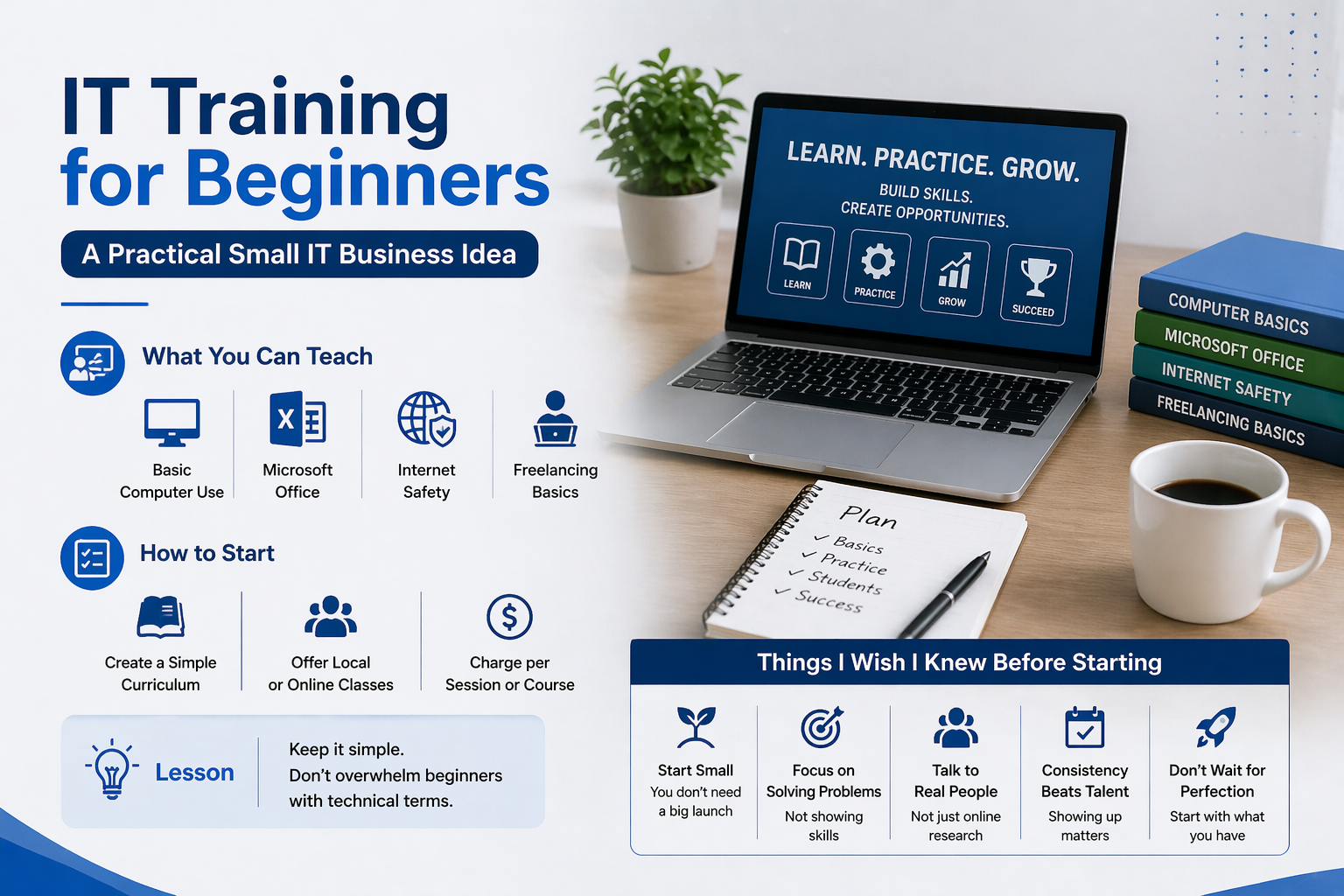
There are many people who want to learn basic computer skills. This also creates opportunities in the cybersecurity services for small business field for beginners.
I once taught a small group how to use Excel and email. It was simple but highly appreciated.
What you can teach:
- Basic computer use
- Microsoft Office
- Internet safety
- Freelancing basics
How to start:
- Create a simple curriculum
- Offer local or online classes
- Charge per session or course
Lesson:
Keep it simple. Don’t overwhelm beginners with technical terms.
Things I Wish I Knew Before Starting
- Start small: You don’t need a big launch
- Focus on solving problems: Not showing skills
- Talk to real people: Not just online research
- Consistency beats talent: Showing up matters
- Don’t wait for perfection: Start with what you have
Final Thoughts
Small IT business ideas are not about building the next big startup. Instead, they are mostly about solving everyday problems that people are actually ready to pay for.
Moreover, when you focus on real needs, it becomes easier to find clients and grow slowly but steadily over time.
Some of these ideas may feel too simple, but that is exactly why they work. In fact, the more practical and useful your service is, the easier it becomes to find clients.
Moreover, this is especially true in a remote IT support business, where people mainly look for quick and simple solutions instead of complex services.
If you’re just starting, pick one idea, test it for a few weeks, and adjust based on real feedback. That’s how most successful IT businesses quietly grow—one small job at a time.
FAQs
1.What is the best IT business to start?
The best IT business to start depends on your skills. However, freelance tech support, website development, and social media management are strong options.
In fact, these businesses are easy to start with low investment, and they can grow over time if you stay consistent and keep improving your skills.
2. What business has a 90% success rate?
No business has a guaranteed 90% success rate. However, service-based businesses like IT support, digital services, and freelancing often have a higher chance of success because they require low startup costs.
Still, success depends on skills, effort, and consistency over time.
3.Is it true that 90% of startups fail?
Yes, it is commonly reported that many startups fail, especially in the early years. However, the exact number is not always 90%.
Moreover, most of these failures happen due to poor planning, lack of market research, or cash flow problems.
4.Who are Gen Z entrepreneurs?
Gen Z entrepreneurs are young business owners born roughly between 1997 and 2012. They often use digital tools, social media, and online platforms to start and grow their businesses. In addition, many of them prefer online or tech-based businesses because they are easier to manage and require less investment.
5.Which business will boom in 2026?
In 2026, many business areas are expected to grow, including AI services, cybersecurity services, freelancing, e-commerce, and digital marketing.
Moreover, IT-related services will grow even more. This is because more work is moving online every year, and businesses are now depending on digital tools more than ever.