

I used to think I was just bad at saving money. Every month I’d earn a decent paycheck and somehow end up with less than $100 left by the 25th. I searched for tips for saving money and kept reading the same recycled advice: make your coffee at home, cancel Netflix, pack your lunch. That advice isn’t wrong. But it also wasn’t enough to actually change anything for me.
The problem wasn’t that I lacked discipline. The problem was that I had no system. I was trying to save through willpower alone. That almost never works. The people who consistently save money don’t rely on motivation , they build structures that make saving automatic and spending hard.
This guide gives you the tips for saving money that actually moved the needle for me and the people I know. These are practical, specific, and designed for real Americans living real lives , not someone with a $150,000 salary and zero obligations. Let’s get into it.
Why Most Tips for Saving Money Don’t Actually Work

Most tips for saving money focus on cutting small expenses. Skip the coffee shop. Stop eating out. Drop the gym membership. These moves save real money , but they also require constant sacrifice and willpower every single day. That is exhausting and unsustainable for most people.
Think of it like a leaky bucket. You can keep scooping water in , but if you never fix the holes, you’re always fighting the same battle. Real money saving tips fix the holes. They change the structure of your finances so savings happen automatically, before you even have a chance to spend the money.
The simplest way how to save cash consistently is to automate it. Pay yourself first , move money to savings the same day your paycheck arrives. Then spend what’s left. That one shift makes most redundant because the savings happen before you decide anything.
Tips for Saving Money That Actually Work Long-Term
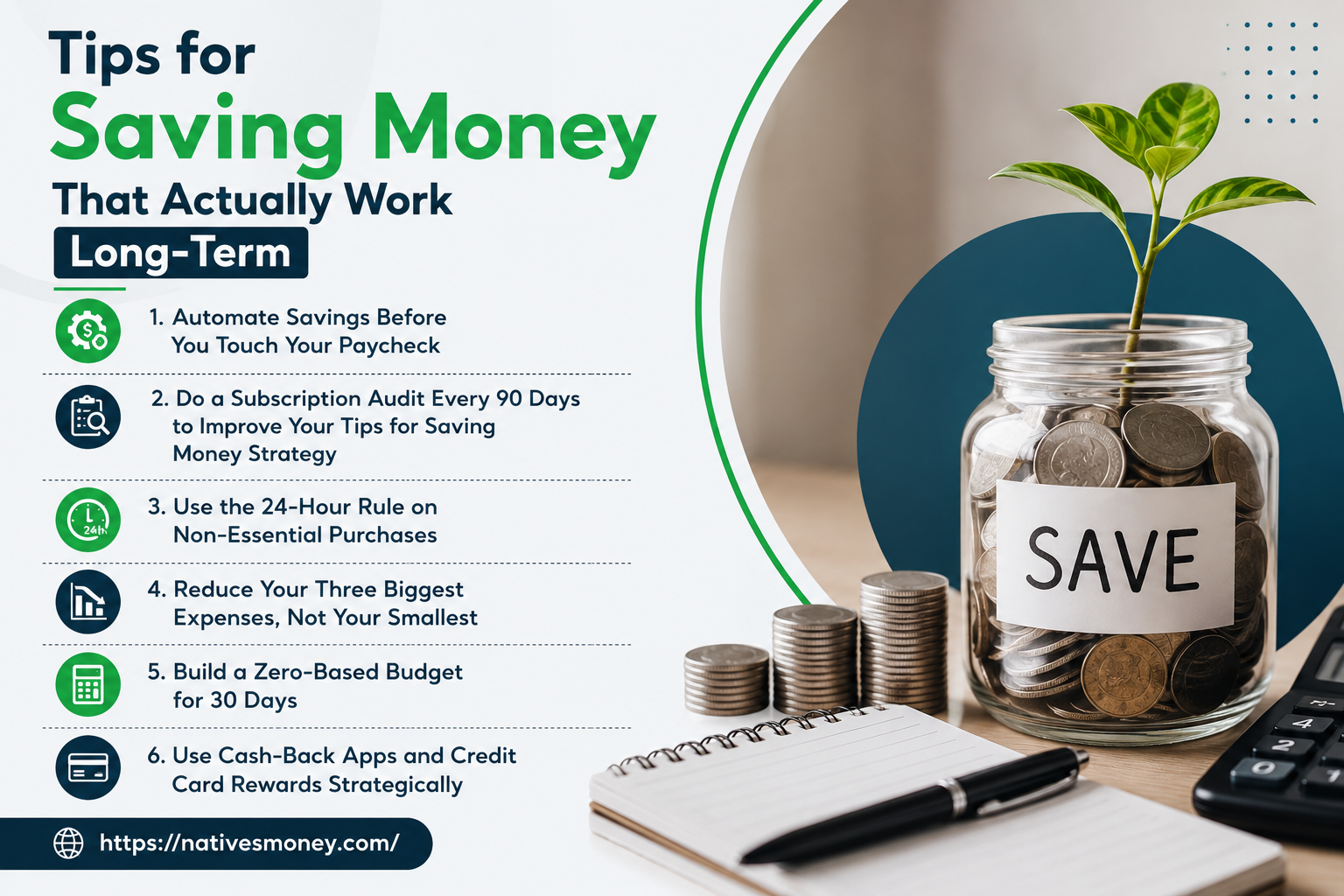
Here are the specific tips for saving money that made a real difference , not in theory, but in practice.
1. Automate Savings Before You Touch Your Paycheck
This is the single most effective of all tips for saving money. Set up an automatic transfer from your checking account to a high-yield savings account the same day you get paid , or set it up through your employer’s direct deposit. Even $100/month saved automatically beats $500 saved manually and inconsistently.
Open a high-yield savings account at Ally, Marcus by Goldman Sachs, or SoFi. These US online banks currently pay meaningfully more than traditional banks. Your money grows while it sits there, and the physical separation from your checking account reduces the temptation to spend it.
2. Do a Subscription Audit Every 90 Days to Improve Your Tips for Saving Money Strategy
Most Americans pay for 5 to 10 subscriptions they barely use. Streaming services, app subscriptions, gym memberships, software tools, meal kits , these add up to $100 to $300 per month for many households. Pull up your last three bank statements and highlight every recurring charge.
Cancel anything you haven’t actively used in the past 30 days. This is one of the fastest how to save cash strategies available. It takes about 20 minutes and saves real money immediately. Set a quarterly calendar reminder to repeat this process.
3. Use the 24-Hour Rule on Non-Essential Purchases
Before you buy anything non-essential over $50, wait 24 hours. For anything over $200, wait 72 hours. This single habit eliminates most impulse spending. When you come back the next day, about 70% of the time you won’t want the item anymore. The urgency was fake.
This is one of those that sounds almost too simple to matter. But it works precisely because it breaks the emotional loop that retailers design. Add it to the cart, then walk away. Most of the time, the cart stays full and your wallet stays intact.
4. Reduce Your Three Biggest Expenses, Not Your Smallest
Housing, transportation, and food typically represent 60 to 80% of most American budgets. Cutting your coffee saves $5 a day. Refinancing your mortgage, getting a roommate, or moving one ZIP code over can save $300 to $800 a month. That’s where the real money is.
On transportation: many Americans overpay for cars. A car payment of $450/month plus insurance of $180/month equals $630/month tied to a depreciating asset. Buying a reliable used car in cash or refinancing to a lower rate is one of the most impactful tips for saving money available , especially compared to skipping a $4 coffee.
5. Build a Zero-Based Budget for 30 Days
A zero-based budget assigns every dollar a job before the month starts. Income minus expenses minus savings equals zero. Nothing goes unaccounted for. Try this for one month using a free tool like YNAB or a simple Google Sheet and you will immediately see where money is disappearing that you never consciously chose to spend.
This exercise alone reveals money saving tips that are specific to your situation , not generic advice. Everyone’s budget leaks differently. Yours might be food delivery. Someone else’s is gas. The budget shows you exactly where to focus your energy.
6. Use Cash-Back Apps and Credit Card Rewards Strategically
If you already spend money on groceries, gas, and household items, you might as well earn something back. Apps like Ibotta, Rakuten, and Fetch Rewards pay you back on purchases you’re making anyway. A cash-back credit card (paid in full every month) can return 2 to 5% on everyday spending.
The key rule: only use credit cards if you pay the full balance monthly. Carrying a balance at 22%+ APR destroys any rewards value immediately. Used correctly, this is free money. Used incorrectly, it’s an expensive debt. One of the most practical money management tips is to treat your credit card exactly like a debit card , spend only what you already have.
Saving Money Mistakes That Keep People Broke
These are the patterns that undo good saving habits faster than almost anything else.
- Saving what’s left instead of spending what’s left. This is the number one enemy of tips for saving money. If you spend first and save whatever remains, you’ll almost never save anything meaningful. Flip the order: save first, then spend the remainder.
- Lifestyle inflation after a raise. Every time income goes up, spending tends to rise with it. This is one of the most common financial success killers. When you get a raise, direct at least 50% of the increase to savings before you adjust your lifestyle to match the new income.
- Not having a separate account for emergencies. Keeping emergency money in your checking account means you will spend it. Open a separate high-yield savings account labeled “Emergency Fund.” Knowing how to save cash effectively starts with separating it physically from your spending money.
- Trying to save everything at once. Starting with a $50/month automatic transfer and building from there works better than aiming for $500/month immediately and quitting when life gets in the way. Consistency over amount , every time.
Here is honest math. If you follow tips for saving money consistently and save $200/month, you have $2,400 after one year. That’s a starter emergency fund and the beginning of real financial breathing room. At $400/month saved, you hit $4,800 , enough to cover most genuine emergencies without going into debt.
The real power comes when you take those savings and put them to work. $400/month in a high-yield savings account gives you $4,800/year. The same $400/month invested in a Roth IRA in a total market index fund at 8% average returns gives you over $590,000 in 30 years. Saving creates the capital. Investing builds wealth. Both steps matter, and tips for saving money are where that journey starts.
Financial success doesn’t require a high income. It requires consistent saving plus consistent investing over time. Americans earning $45,000 a year who apply solid money management tips and save 15% of income can retire comfortably. Those earning $120,000 who spend everything they make cannot. Income is less important than the habits you build around it.
Best Tools to Help You Save More Money in 2026 With Smart Tips for Saving Money
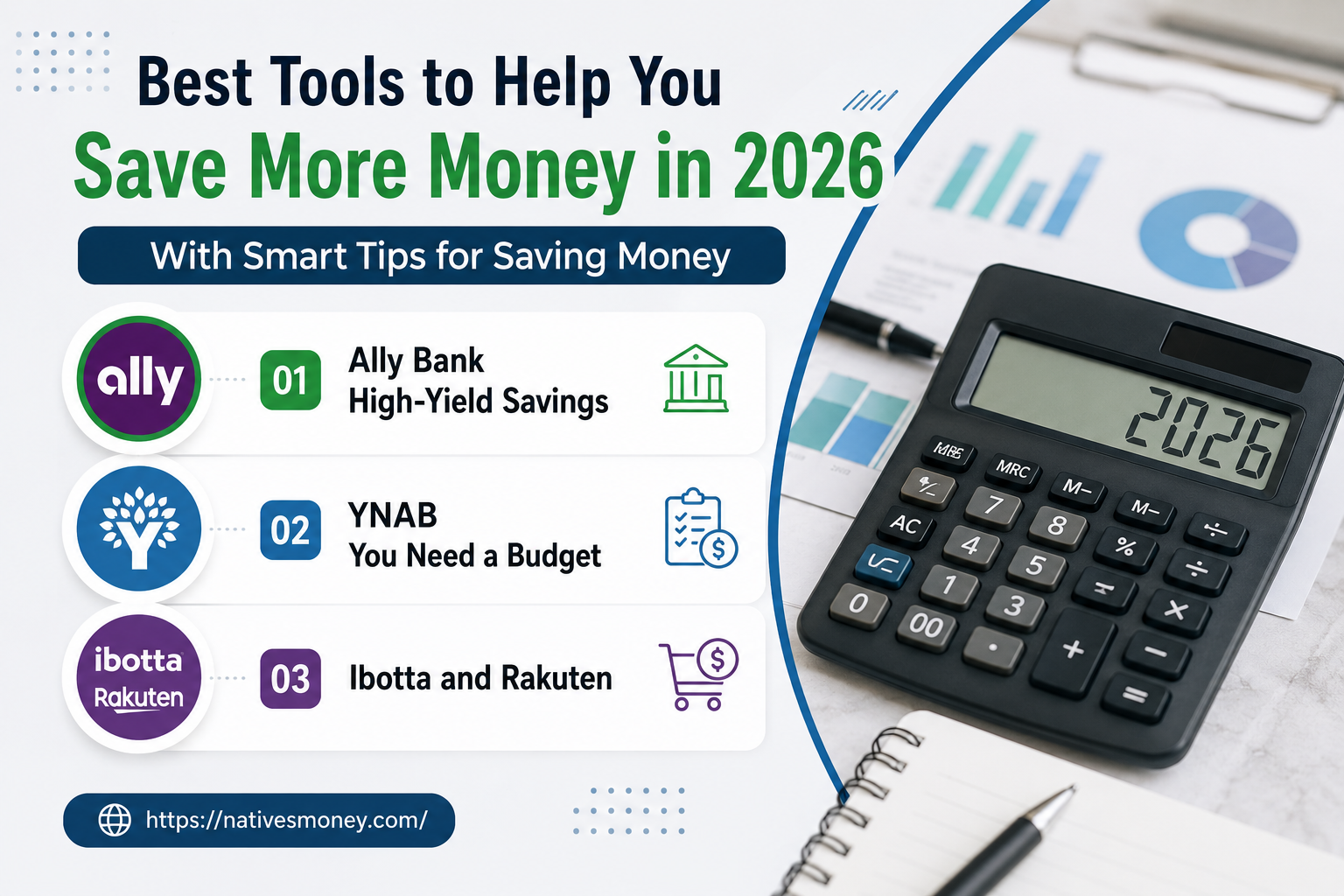
These are the tools I would actually recommend to anyone serious about applying these tips for saving money:
- Ally Bank High-Yield Savings (free) , Competitive APY, FDIC insured, no fees, no minimums. Open separate savings buckets for different goals (Emergency Fund, Vacation, New Car). The visual separation makes these money saving tips concrete and trackable.
- YNAB , You Need a Budget ($14.99/month) , The best budgeting tool for people who want to actually change their financial behavior , not just track spending. YNAB’s zero-based budgeting methodology applies money management tips in a structured, practical way that most apps don’t.
- Ibotta and Rakuten (free) , Earn real cash back on groceries and online purchases you’re already making. Ibotta works at major US grocery chains including Walmart and Kroger. Rakuten covers thousands of online retailers. Passive that requires almost zero behavior change.
If you ever hit a rough patch financially and need short-term relief while you build your savings habits, emergency cash advance: instant funds when you need money fast covers legitimate low-cost options , so you never need to turn to predatory payday loans.
The Bottom Line
The best tips for saving money are not the most complicated ones , they are the most consistent ones. Automate savings first. Cut your biggest expenses, not your smallest. Use a budget that assigns every dollar a purpose. And stay aware of lifestyle inflation so raises actually build wealth instead of disappearing into a higher standard of living.
Start with one tip for saving money this week. For example, open a high-yield savings account, set up an automatic $50 transfer, or do a subscription audit. Even small actions can lead to big results when you stay consistent over time. In addition, every smart financial choice helps you move closer to financial freedom. Keep exploring Natives Money for more honest and practical guides that make saving and managing money easier.
FAQ: Tips for Saving Money in 2026
What are the best tips for saving money fast and managing your budget effectively?
The fastest tips for saving money include canceling unused subscriptions, which can save $50–$200 per month almost immediately. In addition, you should automate a transfer to savings on payday before spending anything else. Furthermore, applying the 24-hour rule to any non-essential purchase over $50 can help reduce impulse buying.
As a result, these three simple steps can free up $200–$400 per month for most Americans within the first 30 days.
How do I actually learn how to save cash when I live paycheck to paycheck?
Learning how to save cash when you live paycheck to paycheck starts with one small automatic transfer, even just $25 or $50 per month. The amount matters less than building the habit of saving regularly.
At the same time, review all your subscriptions and recurring charges to find quick savings. Many people discover $100–$200 per month in forgotten or rarely used services. Then, move that extra money into a separate high-yield savings account right away.
What are the most effective money saving tips for everyday expenses?
The most effective ways to reduce everyday expenses include meal prepping two to three days of meals at once, which helps lower the temptation to order food. In addition, using a grocery list and avoiding shopping while hungry can reduce impulse buying by 30–40%.
You can also save more by buying generic brands for everyday items because they often offer similar quality at a lower price. Moreover, cash-back apps like Ibotta and Rakuten help you earn rewards on purchases you already make. Most importantly, these simple habits help you save money without making major lifestyle sacrifices.
What money management tips actually lead to financial success?
The habits most strongly linked with financial success include saving before spending, keeping a written monthly budget, building a fully funded emergency fund before investing, avoiding consumer debt, and investing regularly in low-cost index funds once your savings foundation is strong.
In addition, financial success does not come from one perfect decision. Instead, it comes from making smart money choices consistently over many years.
How much should I aim to save each month?
A common savings target is 20% of your take-home income. For example, you can save 10% for emergencies and short-term goals, while the other 10% goes toward retirement investing. However, if saving 20% feels too hard right now, start with just 5%. Then, increase it by 1% every three months.
Most importantly, save consistently. Even small amounts help build strong money habits over time. In addition, the exact percentage matters less than simply getting started and staying consistent. You can also apply tips for saving money to find areas where you are spending too much and increase your savings rate more easily.