

Three years ago, I quit a stable job to freelance full-time with almost no plan, no client list, and a vague sense that “freelancing tips” I’d read online would somehow carry me through. They didn’t. I spent my first two months guessing at pricing, applying to jobs I wasn’t qualified for, and genuinely wondering if I’d made the biggest mistake of my career.
What actually worked came later, once I stopped chasing scattered advice and built a real system. This guide is that system , the complete, honest version of freelancing tips I wish someone had handed me on day one instead of letting me figure it out through trial, error, and a fair amount of stress. I’m not going to sugarcoat the hard parts, but I am going to give you a clear, working roadmap.
This is a long guide because freelancing touches a lot of moving parts , choosing your path, pricing your work, finding clients, picking the right tools, managing your money, and understanding what realistic income actually looks like. Think of this as your home base. Throughout, I’ll point you to deeper guides on specific topics, but this article gives you the full picture first. If you’re serious about working for yourself in 2026, these freelancing tips are where you start, and where you can keep coming back to as you grow.
What Is Freelance Work, Really?

Let’s start with the basics, because a lot of people jump into freelancing without a clear picture of what they’re actually signing up for. These freelancing tips can help beginners understand the foundation of this career path. What is freelance work? In simple terms, it’s self-employment where you offer specific skills or services to multiple clients, rather than working for a single employer under a traditional job contract.
Think of it like running a tiny, mobile business. Instead of one boss assigning you tasks every day, you have multiple clients who hire you project by project, and you’re responsible for finding new work, setting your own rates, managing your schedule, and handling your own taxes. These freelancing+tips can help beginners understand how to manage clients, grow their skills, and build a sustainable income stream. There’s no paycheck guarantee, but there’s also no ceiling on how much you can build.
What is a freelancer, in practice? Someone who works independently, usually across digital platforms like Upwork, Fiverr, or direct client relationships, providing services such as writing, design, programming, marketing, consulting, or virtually any skill businesses need but don’t want to hire full-time for. The defining trait is independence , you’re the business, not just an employee of one.
For a more specific example, what is a freelance writer? It’s someone who writes content , blog posts, marketing copy, scripts, technical documentation , for various clients on a project or retainer basis, rather than as a salaried staff writer at one publication. Writing happens to be one of the most accessible entry points into freelancing, which is part of why it comes up so often throughout this guide.
Understanding these definitions matters because freelancing isn’t one single thing , it’s an umbrella covering dozens of different working styles, niches, and income models. Some freelancers work exclusively through platforms. Others build entirely direct client relationships through referrals and outreach. Some freelance part-time around a day job, while others build it into a full-time business with employees of their own eventually. The freelancing tips that work for a graphic designer might look completely different from what works for a virtual assistant or a software developer. This guide covers the principles that apply broadly, while the cluster articles linked throughout go deeper into specific paths.
It’s also worth understanding the difference between freelancing and other forms of self-employment, since people often use these terms interchangeably. A freelancer typically works on discrete projects or short-term contracts for multiple clients. A small business owner usually builds a more structured company, often with employees, fixed location costs, or inventory. A consultant typically offers higher-level strategic advice rather than hands-on deliverable work. Many people start as freelancers and eventually evolve into one of these other categories as their business grows , but freelancing remains one of the lowest-barrier ways to start working for yourself.
The Core Freelancing Tips Every Beginner Needs
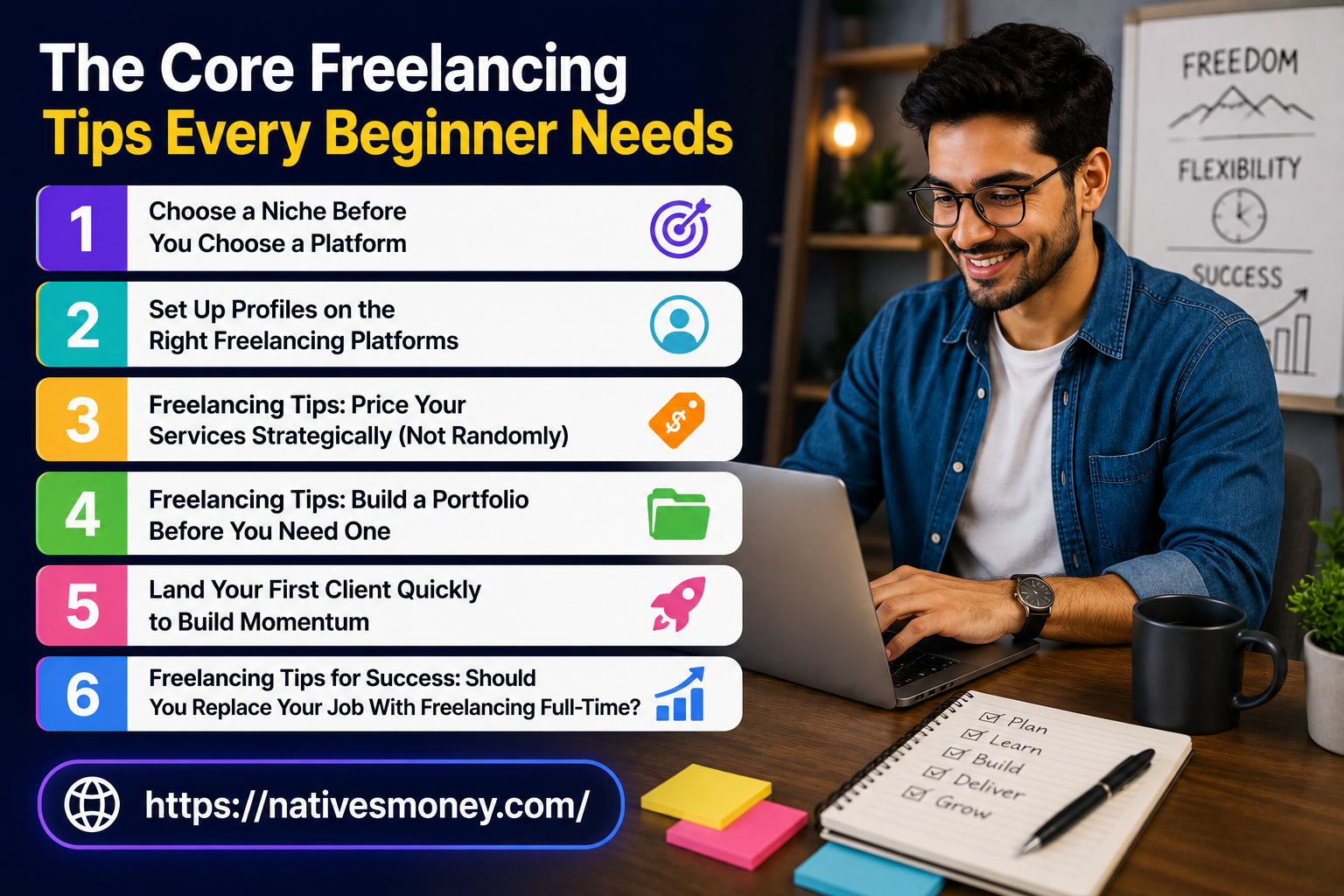
Here’s the foundational system I use and recommend to anyone starting out. These freelancing tips apply regardless of your specific skill or niche, and they build on each other in a specific order for a reason.
1. Choose a Niche Before You Choose a Platform
The single biggest mistake I see beginners make is signing up for Upwork or Fiverr before they’ve decided what they actually want to offer. These freelancing tips can help beginners understand why choosing a clear niche is important before creating a profile. Without a clear niche, your profile reads as generic, and generic profiles get ignored by buyers scanning hundreds of options every day.
A niche does two things for you. First, it makes your marketing and positioning dramatically clearer. “I write blog posts for personal finance brands” beats “I’m a writer” every single time, because the first signals expertise and the second signals you’re still figuring things out. Second, a niche lets you build specialized knowledge faster, which means better work, fewer mistakes, and the ability to charge more as you become known for a specific thing.
I made the mistake early on of being a generalist, offering writing, light design, and basic virtual assistant work all at once. Clients found this confusing, and I found it exhausting to context-switch between completely different types of projects. These freelancing+tips can help you understand the importance of choosing a clear niche and building expertise in one area. Once I narrowed down to financial content writing specifically, both my output quality and my income improved within weeks.
If you’re still deciding what freelance work fits you, our deep-dive guide on the best freelance niches for beginners with no experience walks through specific, accessible options , including writing, virtual assistance, social media management, and basic design work , that don’t require years of prior experience to start earning from. That guide breaks down exactly which niches have the lowest barrier to entry and the most consistent demand on US platforms right now.
2. Set Up Profiles on the Right Freelancing Platforms
Once you know your niche, the platform you choose matters significantly. These freelancing tips can help beginners understand how choosing the right marketplace can impact their growth and client opportunities. Upwork works well for proposal-based, often higher-value projects where clients post detailed job listings and you compete by submitting tailored pitches. Fiverr works well for packaged, fixed-price gigs that buyers find through search, which suits people who want inbound interest rather than constant active pitching.
Beyond these two giants, specialized platforms exist for nearly every niche. Contently and Clear Voice cater specifically to writers working with established brands. Toptal is a higher-bar platform for developers and designers, with a vetting process that screens out a large percentage of applicants but offers access to better-paying clients once you’re in. 99designs works specifically for graphic and logo design through contest-based and direct-hire models. People Per Hour is popular in both the US and UK markets for a broad range of services.
The mistake many beginners make here is trying to maintain a strong presence on five platforms simultaneously before they’ve found traction on even one. These freelancing+tips can help beginners focus on the right strategy instead of spreading their efforts too thin. I’d recommend picking one platform that matches your niche and service style, building a complete and polished profile, and getting your first handful of reviews before spreading yourself across additional platforms.
I cover how I use AI tools to dramatically increase my output across these platforms in Freelancing Platforms: AI Tools That 10x My Output in 2026 , worth reading once you’ve chosen your niche and are ready to actually scale your client volume. That guide breaks down the specific tools and workflow changes that let me take on significantly more projects without working more hours.
3. Freelancing Tips: Price Your Services Strategically (Not Randomly)
Pricing is where most beginners either underprice themselves into burnout or overprice themselves into silence. These freelancing+tips can help you understand the strategy behind setting rates that reflect your actual value while still being competitive enough to land your first few clients. There’s a real strategy to setting rates that balance your skills, experience, and the value you provide to clients.
Most beginners default to one of two extremes. These freelancing tips can help new freelancers understand how to set realistic pricing without undervaluing their skills or overestimating their current market position. Either they price far too low because they’re scared no one will hire them otherwise, which often attracts the most demanding, least respectful clients while paying barely anything for the time invested. Or they price based on what they hope to earn rather than what the market or their current experience level actually supports, which results in proposals that never get accepted.
A better approach is researching what comparable freelancers with similar experience levels are charging on your chosen platform, pricing slightly competitively for your first handful of projects to build reviews, and then raising rates steadily as your portfolio and reputation grow. Most successful freelancers I know raise their rates every few months in their first year, sometimes by 10-20% at a time, as demand for their services increases.
I break down the exact pricing framework I use , including how to raise rates over time without losing existing clients, how to price hourly versus project-based work, and how to handle clients who try to negotiate you down , in How to Price Your Freelance Services in 2026. This is one of the most important freelancing tips in this entire guide, because pricing mistakes compound over your entire freelance career if you don’t fix them early. Underpricing in year one often becomes a hard habit to break by year three.
4. Freelancing Tips: Build a Portfolio Before You Need One
You can’t land clients without proof of your work, but most beginners don’t have client work yet to showcase. These freelancing tips can help new freelancers understand how to build credibility and create opportunities even when they are just starting out. This is the classic chicken-and-egg problem of freelancing, and the solution is building sample projects deliberately, often with AI tools accelerating the process significantly compared to how this used to work.
A strong portfolio doesn’t need to be enormous. Three to five genuinely strong samples that demonstrate range within your chosen niche will outperform a scattered collection of ten mediocre pieces every time. For writers, this might mean creating sample blog posts, email sequences, or product descriptions in your target style. For designers, it might mean mock client projects that show your range across logo work, social graphics, and web design. For virtual assistants, it might mean documenting a sample process or workflow you’d manage for a client.
For a complete walkthrough of how I built my own portfolio from scratch using AI assistance , including the specific tools I used to speed up the creation process and how I structured each sample to actually convert browsing clients into inquiries , see Building a Freelance Portfolio Using AI Tools. A strong portfolio is non-negotiable , it’s the difference between clients trusting your claims and scrolling past your profile to the next freelancer in their search results.
5. Land Your First Client Quickly to Build Momentum
The hardest client to get is always your first one. These freelancing tips can help beginners understand the importance of building trust, collecting reviews, and creating social proof early in their journey. Once you have that initial review and case study, everything after becomes noticeably easier, because new potential clients can see social proof rather than just taking your word for your abilities.
There’s a specific system for accelerating this first step rather than waiting passively for buyers to find you. This includes targeted outreach to specific potential clients rather than mass-applying to everything, offering a slightly discounted or simplified first project specifically designed to be low-risk for a hesitant first-time buyer, and being genuinely responsive and easy to work with during this critical first interaction, since word-of-mouth referrals often start here.
I detail my exact approach, including outreach scripts that actually get responses, platform-specific tactics for Upwork and Fiverr, and how I structured my very first paid project to maximize the chance of a strong review, in How to Get Your First Freelance Client Fast. Don’t skip this step , momentum matters enormously in the early days of freelancing, and a slow start can be genuinely discouraging if you don’t have a system to push through it.
6. Freelancing Tips for Success: Should You Replace Your Job With Freelancing Full-Time?
Not everyone should quit their job to freelance full-time, and not everyone needs to. These freelancing tips can help you evaluate your options, understand the risks, and make smarter decisions about your career path. Understanding the real financial and lifestyle tradeoffs between freelancing and traditional employment helps you make this decision with clear eyes instead of just excitement or fear.
Full-time freelancing means no guaranteed paycheck, no employer-sponsored health insurance (a meaningful consideration in the US healthcare system), no employer 401k matching, and full responsibility for your own taxes including self-employment tax. It also means no income ceiling tied to a single salary, complete control over your schedule, and the ability to scale your business in ways a traditional job simply doesn’t allow.
Many successful freelancers start part-time, building a client base and proving the income is consistent before making the leap away from full-time employment. These freelancing tips can help beginners choose the right approach based on their goals, financial situation, and risk tolerance. Others jump in fully from the start, accepting more initial risk in exchange for faster growth, since dividing attention between a job and a freelance business can slow momentum considerably.
I compare both paths honestly, including income stability, benefits, healthcare considerations, and growth potential, in Freelance vs Full-Time: Which Pays Better in 2026? , a guide I wish I’d read before making my own leap, since I jumped in without fully understanding what I was giving up financially in the short term.
Freelancing Tips: Building the Right Tools and Systems Around Your Freelance Business
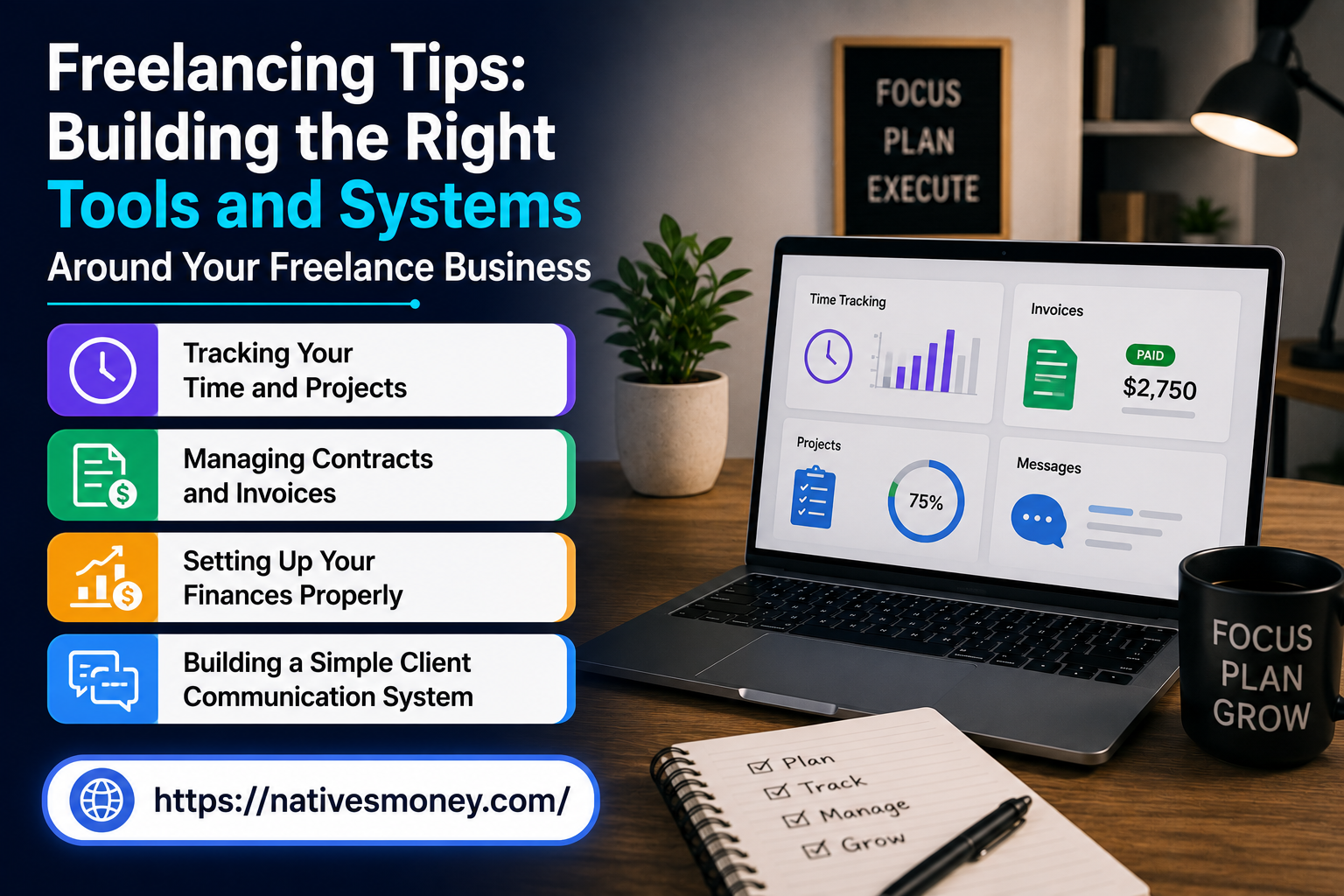
Beyond the six core steps above, the freelancers who succeed long-term tend to build supporting systems around their actual service work. These freelancing tips can help beginners understand that success is not only about finding clients but also about creating efficient processes for managing a sustainable business. These aren’t optional extras ,they’re what separates a sustainable freelance business from a chaotic side hustle that eventually burns someone out.
Tracking Your Time and Projects
Even if you charge per project rather than per hour, tracking your actual time investment matters enormously. These freelancing tips can help beginners understand why monitoring time, analyzing project profitability, and adjusting rates based on real data are essential for building a sustainable freelance business. I use a simple time tracker for the first few months of any new type of project to understand my true hourly rate, then adjust my project pricing accordingly. Without this data, it’s easy to underprice work that actually takes far longer than expected, which quietly erodes your income without you realizing why.
Managing Contracts and Invoices
Beyond the six core steps above, the freelancers who succeed long-term tend to build supporting systems around their actual service work. These freelancing tips can help beginners understand that success is not only about finding clients but also about creating efficient processes for managing a sustainable business. These aren’t optional extras ,they’re what separates a sustainable freelance business from a chaotic side hustle that eventually burns someone out.
Setting Up Your Finances Properly
Opening a separate business checking account, even as a sole proprietor, makes tracking income and expenses dramatically easier come tax season. These freelancing tips can help beginners develop better financial habits, organize their freelance income, and avoid unexpected tax-related stress. I also recommend setting up a dedicated savings account specifically for taxes, where you transfer 25-30% of every payment the moment it arrives. This single habit has saved me from financial stress every single tax season since I started doing it.
Building a Simple Client Communication System
As your client base grows, keeping track of who you’re talking to, what stage each project is at, and when follow-ups are due becomes genuinely difficult without a system. These freelancing tips can help you stay organized by using the right tools and processes to manage client relationships effectively. A simple spreadsheet works fine at first; tools like Trello or Notion work well once you’re managing multiple ongoing client relationships simultaneously.
Mindset Shifts That Make Freelancing Sustainable
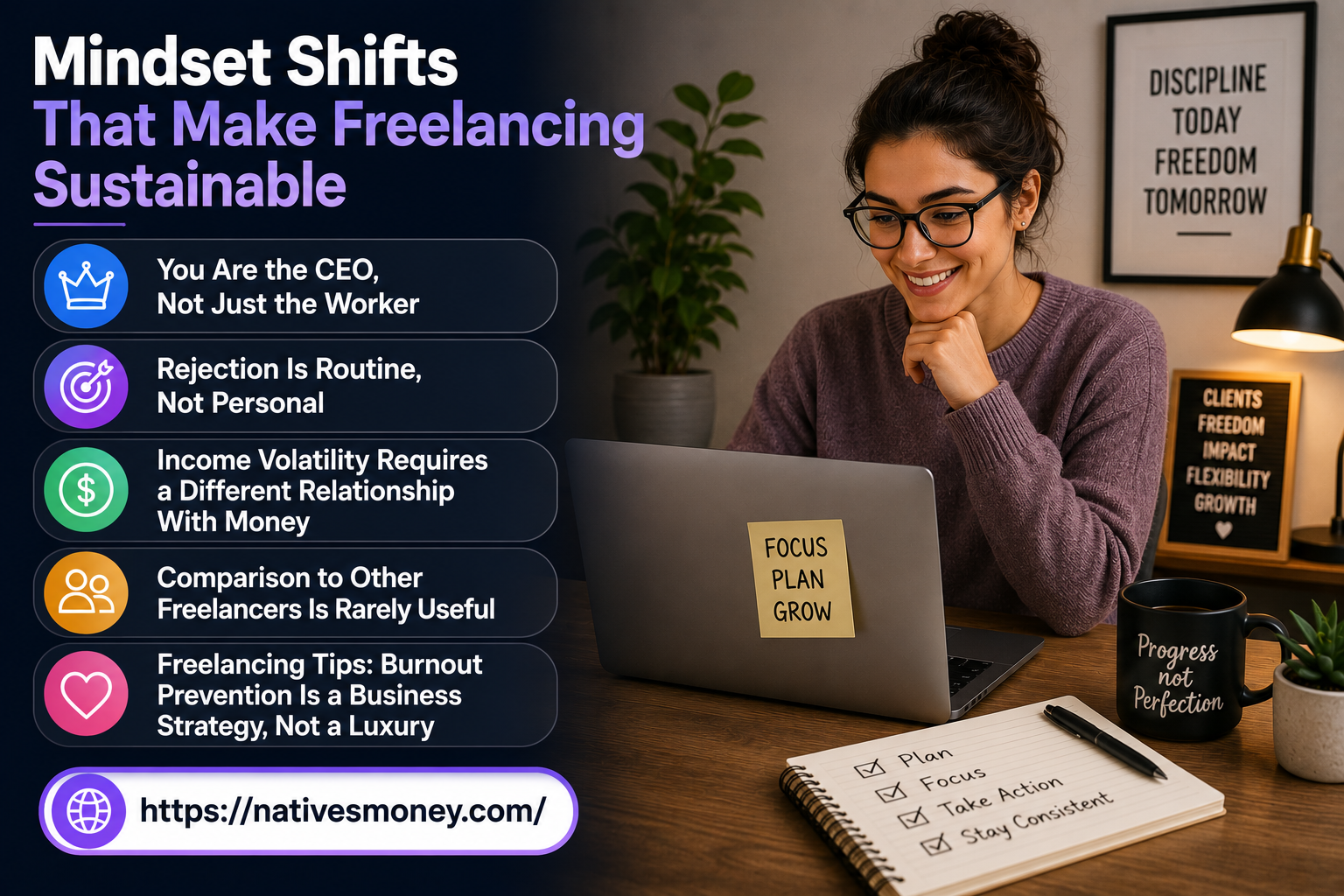
Beyond systems and tools, there’s a mental shift that happens for most people who succeed long-term as freelancers, and it’s worth naming directly because it’s rarely discussed in typical freelancing tips content.
You Are the CEO, Not Just the Worker
When you’re employed, someone else handles strategy, sales, and business decisions, and you focus purely on your craft. These freelancing tips can help beginners understand that running a freelance business requires balancing creative work with planning, communication, and management responsibilities. As a freelancer, you’re doing both jobs simultaneously, even on days when you’d rather just do the creative or technical work you actually enjoy. Accepting this dual role early prevents the common frustration of feeling like administrative tasks are “getting in the way” of your real work, when in reality they are part of the real work.
Rejection Is Routine, Not Personal
Early in my freelance career, every unanswered proposal or declined pitch felt like a personal judgment. These freelancing tips can help beginners develop the right mindset and understand that rejection is a normal part of building a freelance career. Over time, I learned that most rejections have nothing to do with your skill level ,budget mismatches, timing, or a client simply choosing someone they already knew are far more common explanations. Freelancers who last build a thicker skin around this fairly quickly, because constant client acquisition is simply part of the job.
Income Volatility Requires a Different Relationship With Money
Traditional employment trains us to expect the same paycheck every two weeks. Freelance income rarely works this way, especially in the first year, with some months bringing in far more than others. These freelancing tips can help beginners prepare for income fluctuations, build financial stability, and develop better budgeting habits before relying on freelance work full-time. Building a financial buffer ,even a modest one ,before going full-time, and getting comfortable budgeting around an average monthly income rather than expecting consistency, makes this transition significantly less stressful.
Comparison to Other Freelancers Is Rarely Useful
It’s tempting to measure your progress against freelancers who seem to be earning more, faster, often visible through social media posts showcasing their best months rather than their average ones. These freelancing tips can help beginners stay focused on personal growth and avoid unrealistic comparisons while building their careers. Niches, starting points, time availability, and even geographic cost of living all affect what “success” looks like for any individual freelancer. Focusing on your own consistent month-over-month progress is a far more useful measuring stick than comparing yourself to a curated highlight reel.
Freelancing Tips: Burnout Prevention Is a Business Strategy, Not a Luxury
Several freelancers I know hit a wall around month six to nine, having taken on too much client work without building in any buffer time, leading to either declining quality or a complete crash that set their business back months. These freelancing tips can help beginners understand the importance of managing workload, setting boundaries, and creating a sustainable routine before growth creates unnecessary pressure. Building deliberate breaks, realistic weekly capacity limits, and boundaries around working hours into your business model from the start isn’t indulgent ,it’s what allows the business to actually survive long enough to become genuinely sustainable.
Common Mistakes That Derail New Freelancers
These are mistakes I made personally, plus patterns I’ve seen repeatedly in other beginning freelancers.
Mistake #1: Underpricing out of fear. I priced my first gigs so low that I was essentially working for less than minimum wage once you factored in actual hours spent. These freelancing tips can help beginners understand the importance of valuing their skills, setting fair rates, and avoiding pricing strategies that limit long-term growth. Low prices don’t guarantee clients — they often attract the most demanding ones while paying you the least, and they make it psychologically harder to raise rates later since existing clients get used to your lowest pricing.
Mistake #2: Applying to everything instead of targeting fit. Early on, I sent generic proposals to dozens of jobs I wasn’t well-suited for, hoping volume would work in my favor. It rarely did. Targeted, specific proposals to jobs that genuinely match your skills and niche convert far better than mass outreach, and they take less cumulative time since you’re not constantly rewriting pitches from scratch.
Mistake #3: Treating freelancing like a hobby instead of a business. For months, I didn’t track expenses, didn’t set aside money for taxes, and didn’t have any system for following up with past clients. These freelancing tips can help beginners understand that success requires more than just completing projects ,it also depends on strong financial habits, organization, and maintaining client relationships. Freelancing only works long-term when you treat it with the same seriousness as any small business, including basic financial discipline and consistent client relationship management.
Mistake #4: Ignoring client communication skills. Technical skill alone doesn’t keep clients coming back. These freelancing tips can help beginners understand that strong communication, reliability, and professionalism are just as important as technical ability when building long-term client relationships. Clear, prompt, professional communication is often what separates freelancers who build repeat business from those stuck constantly chasing new one-off projects. A client who feels well-informed throughout a project is far more likely to hire you again, even if a competitor’s raw skill level is technically comparable.
Mistake #5: Not setting boundaries around scope and availability. Early on, I said yes to every revision request and answered client messages at all hours, assuming this made me look dedicated. These freelancing tips can help beginners understand the importance of setting boundaries, managing client expectations, and creating a healthier workflow. Instead, it set an unsustainable precedent and led to burnout within a few months. Clear scope definitions and reasonable response-time expectations protect both you and the long-term quality of your client relationships.
Freelancing Tips: What to Realistically Expect from Freelancing in 2026
I want to set honest expectations here, because so much freelancing content online oversells the timeline. These freelancing tips can help beginners understand that building a successful freelance career takes patience, consistent effort, and realistic goals. Here’s what a realistic first year actually looks like, based on my own experience and patterns I’ve seen across many freelancers I know personally.
Month one to two: This is foundation-building. Setting up profiles, building a portfolio, and applying or pitching consistently. Income during this phase is often $0-300, and that’s completely normal. Most of your time investment here doesn’t show up directly as income yet, but it’s the groundwork everything else depends on.
Month three to four: With your first few client relationships established and early reviews on your profile, income typically reaches $500-1,200/month depending on your niche and how much time you’re dedicating. These freelancing tips can help beginners understand that building momentum, gaining client trust, and improving your service quality are key steps toward increasing freelance income. This is usually when freelancing starts feeling real rather than experimental.
Month five to eight: Freelancers who stay consistent and apply solid pricing strategy often see income climb to $1,500-3,000/month, with some niches like development, consulting, or specialized writing reaching higher numbers faster than others. Repeat clients typically start making up a meaningful portion of income by this stage.
Year one and beyond: Full-time freelance income of $3,000-6,000+/month is realistic for freelancers who’ve built systems around client acquisition, pricing, and consistent delivery. These freelancing tips can help beginners understand that long-term success depends on building strong processes, improving skills, and creating reliable income streams ,though this absolutely varies significantly by niche and effort level. Some specialized freelancers (developers, consultants, experienced designers) reach this level faster; others in more saturated niches take longer and need stronger differentiation.
On the US tax side, freelance income is self-employment income. You’re responsible for both portions of Social Security and Medicare tax (often called self-employment tax), and once your net earnings exceed $400/year, you’re required to file a Schedule C with your tax return. Most freelancers also need to make quarterly estimated tax payments to the IRS to avoid underpayment penalties , set aside 25-30% of every payment from day one to make this manageable rather than facing a painful surprise the following April.
It’s also worth understanding deductible business expenses as a freelancer. These freelancing tips can help beginners manage their finances better and understand how business deductions can reduce taxable income. Home office space (if used regularly and exclusively for business), software subscriptions, a portion of internet costs, professional development courses, and even a portion of health insurance premiums for self-employed individuals can often be deducted, reducing your taxable income. Working with a tax professional in your first year, even briefly, is a worthwhile investment to make sure you’re capturing these correctly.
Best Tools and Resources for Freelancers in 2026: Essential Freelancing Tips
Here are the core tools I recommend to anyone serious about building a freelance career.
Upwork and Fiverr remain the two most accessible freelancing platforms for US-based freelancers across nearly every service category, and I’d recommend starting with at least one of them while you build a direct client network over time.
ChatGPT or Claude (both free tiers available) are essential for speeding up research, drafting, and client communication across nearly any freelance niche. These freelancing tips can help beginners understand how AI tools can improve efficiency and create a smarter workflow. These tools genuinely change how much work you can take on without burning out, and they’re worth integrating into your workflow early rather than after you’ve already established slower habits.
Bonsai (US-based freelance business platform) handles contracts, invoicing, and basic accounting in one place, which becomes valuable once you’re managing multiple clients and need to look and operate professionally without spending hours on administrative work.
QuickBooks Self-Employed is worth considering once your income grows, since it specifically simplifies tracking deductible expenses and estimating quarterly tax payments for freelancers and sole proprietors in the US. These freelancing tips can help beginners understand the importance of organizing finances, tracking expenses, and preparing for tax responsibilities as their freelance business grows.
For more practical strategies on building income and growing as an entrepreneur, the Entrepreneurship section at Natives Money has additional real-world guides worth exploring alongside this one.
The Bottom Line
The best freelancing tips aren’t secret hacks , they’re a clear system: pick a niche, price strategically, build proof of your work, find your first client fast, decide intentionally whether to go full-time, and treat the whole thing like a real business from day one. Freelancing in 2026 is genuinely more accessible than ever, especially with AI tools handling so much of the repetitive work that used to eat up beginners’ time and energy.
If you’re serious about working for yourself, don’t try to absorb everything at once. These freelancing tips can help you focus on the right steps at the right time instead of overwhelming yourself with too much information. Start with the foundational steps in this guide, then dive into whichever cluster article matches where you are right now ,whether that’s choosing a niche, pricing your first project, building your portfolio, or landing your first client. For more honest, experience-based income strategies, keep exploring nativesmoney.com.
Frequently Asked Questions
What is freelance work and how is it different from a regular job?
What is freelance work comes down to self-employment , you offer services to multiple clients on a project basis instead of working for one employer under a traditional contract. Unlike a regular job, freelancers set their own rates, choose their own clients, and are responsible for their own taxes, but they also have no guaranteed paycheck or built-in benefits like employer-sponsored health insurance or 401k matching. These freelancing tips can help beginners understand the responsibilities of self-employment and prepare for both the freedom and challenges that come with running a freelance business.
What is a freelancer expected to do day-to-day?
What is a freelancer’s typical day usually includes a mix of client work, pitching or applying for new projects, invoicing, and basic business administration like tracking expenses. Unlike traditional employment, freelancers manage their own schedule entirely, which offers flexibility but requires real self-discipline to stay productive and consistent without an employer setting structure for them. These freelancing tips can help beginners create better routines, manage their time effectively, and build the discipline needed to succeed in a flexible work environment.
What is a freelance writer and how do they get started?
What is a freelance writer? Someone who writes content for various clients , blog posts, marketing copy, scripts, or technical documentation , on a project or retainer basis rather than as a salaried employee at one company. Most freelance writers start by building a small portfolio of sample work, then pitching clients directly or applying through platforms like Upwork and Fiverr to land their first paying projects. These freelancing tips can help beginners understand that creating proof of skills and consistently reaching out to potential clients are key steps toward building a successful writing career.
What are the best freelancing tips for someone just starting out in 2026?
The best freelancing tips for beginners include choosing a specific niche before signing up for any platform, building a small portfolio of sample work, pricing services strategically rather than guessing, and focusing on landing one solid first client to build momentum. Treating freelancing like a real business from day one, including tracking income and expenses, makes a significant long-term difference in how sustainable your freelance career becomes.
How long does it take to make a full-time income from freelancing?
Most freelancers following solid freelancing tips and a consistent system see meaningful part-time income ($500-1,200/month) within three to four months, with full-time-level income ($3,000+/month) typically achievable within six to twelve months for those who stay consistent. The exact timeline varies significantly depending on niche, pricing strategy, platform choice, and how much time you can dedicate weekly to building your client base.