
I used to think you needed a business degree, a rich uncle, or a garage in Silicon Valley to start a company. I had none of those things. What I had was a laptop, a slow internet connection, and evenings I wasn’t using for much. Figuring out how to start a side business felt overwhelming at first. The first time I sat down to actually register something, I stared at the form for two hours and closed the tab without finishing it. If that sounds familiar, this article is for you.
Here’s the truth: learning how to start a side business in 2026 doesn’t require permission from anyone. It doesn’t require a perfect plan, a huge bank account, or a background in finance. What it does require is a clear process , one that takes your side project from “just an idea” to a real, working business you can eventually go all-in on. That’s exactly what this founder’s playbook is going to give you.
In this guide, I’m walking you through everything I wish someone had handed me on day one: how to start a side business the right way, how to validate small business ideas before you build anything, how to decide between bootstrapping and raising money, which tools actually matter for a solo founder, and the mistakes that cost me time, money, and sleep. Consider this your dummies guide to starting a business , written by someone who learned most of it the hard way, not a textbook.
How to Start a Side Business, Explained Simply

Learning how to start a side business really comes down to one idea: find a problem people already have, and solve it for them in a way they’re willing to pay for, on a schedule that doesn’t require quitting your day job first. That’s it. It doesn’t need to be a tech startup or a “disruptive” app. Some of the best small business ideas I’ve seen started as side projects that looked boring on paper , a laundry pickup service, a local bookkeeping practice, a niche newsletter , and became genuinely profitable once the founder gave them consistent, part-time attention.
Think of it like building a bridge in your spare time, plank by plank, instead of trying to build the whole thing in one weekend. On one side is a problem your future customers have. On the other side is the outcome they want. Figuring out how to start a side business is really just figuring out how to build that bridge a little at a time, around a job, a family, or whatever else already fills your week.
When people ask me for business ideas business owners can realistically start part-time, I always steer them toward three categories: services (you trade skills for money directly), products (you make or source something and sell it), and content or audience-based businesses (you build attention and monetize it later). Almost every one of the small business enterprise ideas I’ve tried or watched succeed falls into one of these three buckets. Once you know which bucket fits your skills and time, the actual “how” of getting started gets a lot less scary.
Types of Side Businesses to Consider in 2026
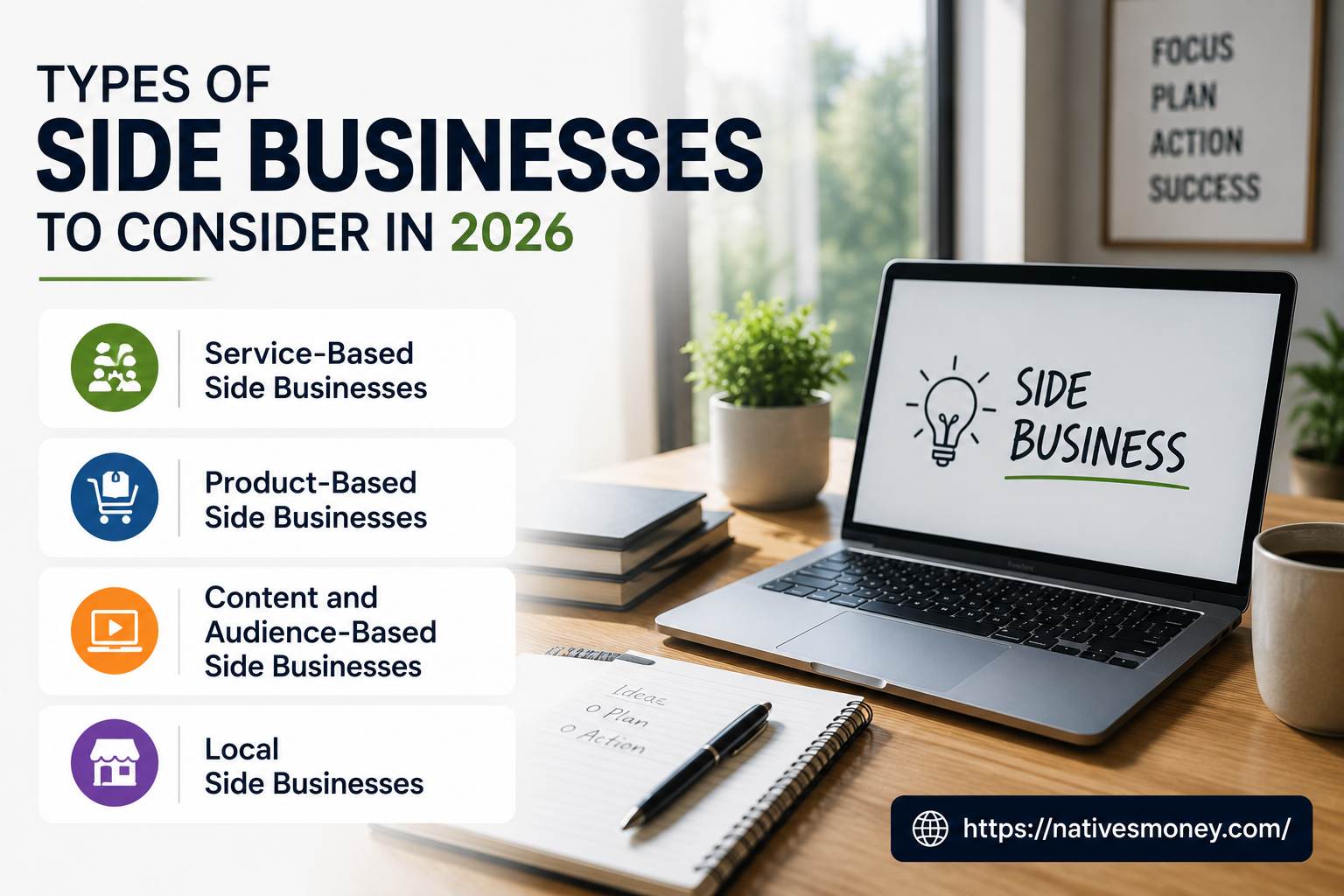
Not every founder wants the same kind of business, and that’s a good thing. Before you dig deeper into how to start a side business, it helps to see the main categories laid out clearly, so you can match one to your actual skills, schedule, and risk tolerance instead of copying whatever’s trending online.
Service-Based Side Businesses
These are the fastest way to figure out how to start a side business because they don’t require inventory or manufacturing , just a skill someone will pay for. Freelance writing, virtual assistance, bookkeeping, social media management, tutoring, and local handyman work all fall here. Most of my own small business ideas over the years have been service-based, simply because they let me start earning within days instead of months. The tradeoff is that your time is the product, so growth usually means hiring, not just working harder.
Product-Based Side Businesses
This category covers anything physical or digital that you make, source, or manufacture and then sell, whether you’re exploring how to start a side business with an Etsy shop, a small-batch food brand, a print-on-demand storefront, or a niche Amazon FBA product. Product-based small business enterprise ideas take longer to launch since you need sourcing, packaging, and often some upfront inventory cost, but they can scale without your direct time being the bottleneck once systems are in place.
Content and Audience-Based Side Businesses
This is the slowest category to monetize but often the most durable in the long term. If you’re researching how to start a side business, a niche blog, YouTube channel, newsletter, or podcast can be an excellent choice because you build an audience first and then monetize through ads, affiliate income, sponsorships, or your own digital products. I’ve watched several small business enterprise ideas in this category take a full year to gain traction and then quietly become someone’s biggest income stream by year three.
Local Side Businesses
Not everything has to live online. If you’re wondering how to start a side business, local service businesses such as lawn care, cleaning, mobile pet grooming, and small retail still make up a huge share of profitable business ideas that owners run part-time in the US, and they benefit from less competition than saturated online niches. The tradeoff is a higher operating cost and, often, some form of licensing depending on your city or state.
Whichever category fits, the same core question applies: how do you start a side business in that category without it taking over your whole life before it’s proven itself? The playbook below answers that regardless of which type you pick.
How to Start a Side Business Step by Step

Step 1: Validate Your Idea Before You Build Anything
Before you spend a single evening building, test whether people actually want what you’re planning to sell. This is the step most guides on how to start a side business skip, and it’s where a lot of ideas die quietly , not because they were bad, but because nobody checked first. I now use AI tools to speed this up: I’ll ask an AI assistant to pull common complaints from Reddit threads, Amazon reviews, or forum posts in my target niche, then cross-check that against basic search volume on tools like Google Trends or Ubersuggest.
A simple validation loop looks like this: post about the idea in a relevant Facebook group or subreddit, DM ten strangers who match your target customer, and ask if they’d pay for it today. If nobody says yes, that’s data, not failure. I skipped this step the first time I tried figuring out how to start a side business and spent four months building something exactly zero people wanted.
Validation doesn’t need to be scientific. It needs to be honest. Ask yourself: would a stranger pull out their card for this right now, or am I hoping they eventually will? That one question has killed more bad ideas of mine than any spreadsheet ever could.
Step 2: Protect Your Day Job Income While You Test
Almost nobody needs to quit their job on day one, and honestly, almost nobody should. The real answer to how to start a side business without financial panic is simple: keep the steady paycheck while you test. I kept my day job for the first eleven months of my business and used evenings and weekends to build it, which removed most of the pressure that causes people to make rushed decisions.
If you’re wondering how to build momentum without burning out, the answer is smaller blocks of consistent time, not heroic all-nighters. I blocked ninety minutes most weekday evenings and three hours on Saturdays. That was enough to launch, land my first five customers, and prove the idea actually had legs before I risked my main income.
There’s no single “right” schedule for how to start a side business. Some people carve out early mornings before work, others use lunch breaks, and some save everything for weekends. What matters is picking a rhythm you can actually sustain for six to twelve months, since that’s roughly how long a new venture takes to prove itself part-time.
Step 3: Decide Between Bootstrapping and Raising Capital
This is one of the biggest forks in the road for any new founder, and it’s more personal than most advice admits. Bootstrapping means funding the business yourself, from savings or early revenue, and keeping full ownership and control. Raising capital means bringing in investors, which can fund faster growth but comes with pressure, dilution, and reporting to people who aren’t you.
I bootstrapped my first attempt at business ideas business ventures and it was slow, but I never had to answer to anyone. A friend of mine raised a small seed round for her app and grew ten times faster , but she’ll tell you the board meetings and growth targets kept her up at night. Neither path is wrong. Ask yourself honestly: do I need speed, or do I need control? Most people learning how to start a side business, especially a service-based one, don’t actually need outside money to get off the ground.
Step 4: Build Your Tool Stack (Don’t Overbuy)
When I started, I bought every tool the internet told me I “needed” and used about a third of them. For most solo founders in 2026, you really only need five categories covered: a way to get paid (Stripe or Square), a way to manage your money (Wave or QuickBooks), a place to build your online presence (Squarespace, Shopify, or a simple WordPress site), a way to talk to customers (a shared inbox like Help Scout, or honestly just email), and a project tracker (Notion or Trello).
That’s the entire stack for most people still working out how to start a side business at the early stage. Resist the urge to buy a CRM, an automation suite, and three analytics dashboards before you’ve made your first sale. Add tools only when the lack of that tool is actually costing you time or money , not before.
I’ve watched people spend more time picking the “perfect” project management app than actually working the project. If you’re building on a tight budget, free tiers of these tools will carry you further than you’d expect. I ran my entire first year on free-tier software, and it was more than enough to run several small business ideas at once while I figured out which one had real traction. A rough budget for year one: expect $0–$50/month if you stick to free tiers and pay-as-you-go payment processing, versus $150–$300/month once you add paid plans across bookkeeping, email marketing, and a premium website builder.
The mistake most people make when learning how to start a side business isn’t picking the wrong tool—it’s choosing tools before they have a customer to serve. Buy the paid plan when the free plan is actually holding your progress back, not before. And always check whether a tool offers an annual discount before committing to monthly billing; many platforms knock 15–20% off if you pay yearly once you’re confident you’ll stick with them. This is the kind of detail that separates people who casually test business ideas from those who actually commit to building a long-term business.
Step 5: Know When to Move From Side Hustle to Registered Business
There’s a specific moment when a side hustle needs to become a legal business, and it’s not when you feel ready , it’s when the numbers or the risk say so. In the US, that’s usually when you’re consistently earning enough that self-employment taxes matter, when you’re taking on any liability risk (client contracts, physical products, employees), or when a client specifically requires you to be an LLC to work with them.
Registering is simpler than people expect: for most solo founders, an LLC through your state’s Secretary of State website costs somewhere between $50 and $500 depending on the state, and you can usually finish it in an afternoon. I put this off for over a year out of fear, and the actual process took me forty-five minutes once I sat down to do it. Don’t let this step be the thing that stalls your progress after you’ve already figured out how to start a side business successfully.
Knowing this transition point in advance matters, so you’re not scrambling to register after a client has already asked for your business’s legal name on a contract. Most states let you file the paperwork online in one sitting, and many also require a simple annual report afterward , mark that date on your calendar so your business doesn’t accidentally lapse into non-compliance a year later.
Step 6: Set Up Simple Systems Before You Scale
Once you understand how to start a side business and you’re generating steady revenue, put a few boring systems in place: a separate business bank account, a simple monthly bookkeeping habit, and a basic pricing sheet so you’re not renegotiating from scratch every time. These aren’t exciting, but they’re what separates a side business that survives year two from one that quietly folds.
Step 7: Revisit Your Plan Every Quarter
Your business isn’t static. Revisit your offer, your pricing, and your tool stack every three months. What worked at $0 in revenue often needs adjusting at $5,000 a month, and again at $50,000 a month. The people who figure out how to start a side business and keep it profitable long-term are the ones who revisit and adjust, not the ones who leave it on autopilot.
Common Mistakes People Make When Starting a Side Business
If you’re learning how to start a side business, let me save you some pain. These are mistakes I made personally, plus ones I’ve watched other first-time founders make repeatedly.
Skipping validation because the idea “feels right.” Gut feeling is not the same as evidence. Talk to real people before you build.
Overspending on tools and branding before the first sale. I spent $600 on a logo before I had a single paying customer. That money should have gone toward actually reaching customers.
Treating bootstrapping as a moral badge instead of a strategic choice. If you’re learning how to start a side business, remember that bootstrapping is only one option, not a requirement. Sometimes raising a small amount of capital is genuinely the smarter move—don’t rule it out just for the sake of “doing it alone.”
Waiting too long to register the business. Fear of paperwork kept me operating as an unregistered side hustle far longer than made sense, which meant I had zero liability protection during a period when I actually had clients and contracts.
Ignoring the numbers. I didn’t track expenses for the first six months and had no real idea if I was profitable. Turns out I wasn’t, for a while.
Trying to do everything full-time immediately. Resist the urge to quit your job the same week you land your first customer. If you’re still learning how to start a side business, give it a few real months of part-time proof before you bet your full income on it.
Assuming you need to know everything before you start. Nobody starting out actually knows how to price a service, write a contract, or file quarterly taxes. You learn each of these one at a time, as they come up. If you’re following this as a dummies guide to starting a business, treat “I don’t know how” as a normal, temporary state, not a reason to wait.
What to Realistically Expect When Starting a Side Business
Here’s the honest version, not the highlight-reel version: most people who figure out how to start a side business take twelve to eighteen months to become genuinely profitable, not twelve to eighteen weeks. The first few months are almost entirely setup, testing, and adjusting. Revenue, when it comes, tends to be inconsistent before it becomes reliable.
According to the Bureau of Labor Statistics, roughly one in five new businesses in the US doesn’t survive its first year, and about half don’t make it past year five. That’s not meant to discourage you , it’s meant to set realistic expectations so you don’t quit at month four assuming you’ve failed when you’re actually still in the normal setup phase.
I hit profitability around month fourteen with my first real attempt, after two earlier failed attempts that never made it past month three. The founders who make it past year one usually share one trait: they adjusted the offer instead of quitting the whole idea when something wasn’t working.
If you’re figuring out how to start a side business, expect the first three to six months to feel like almost nothing is happening, especially if you’re working nights and weekends. That’s normal. The compounding effect of consistently testing and refining your business tends to show up later than most people expect, and then all at once.
Here’s a real example. A friend who started a bookkeeping service for local contractors landed exactly one client in her first two months , a friend of a friend, at a discounted rate. By month five she had four clients and had raised her price twice. By month eleven, referrals alone were bringing in more leads than she could take on, and she raised her rate a third time and started a short waitlist. Nothing about that timeline was fast, but it was steady, and steady is what actually compounds.
Money-wise, it’s worth setting expectations in real numbers instead of vague optimism. Most service-based side businesses I’ve seen bring in somewhere between $500 and $2,000 a month in year one, once they’ve found their footing , enough to matter, but rarely enough to replace a full-time salary right away. Product and content-based side businesses often start slower on revenue but can scale faster once the systems behind them are built out, since they’re not as tightly capped by your personal hours.
One thing you’ll quickly learn about how to start a side business is that the biggest variable isn’t luck—it’s whether you keep showing up on the weeks when nothing seems to be working. Almost every founder I know can point to a two- or three-month stretch where they seriously doubted the idea, right before things picked up. That stretch is normal, not a red flag.
US Tax and Legal Basics Every New Founder Should Know
Nobody warns you about this part, so let’s cover it plainly. If you’re learning how to start a side business, understanding your tax responsibilities from day one is just as important as finding customers. Once you start earning money outside a W-2 job, the IRS treats you as self-employed, which means you’re responsible for both the employer and employee portions of Social Security and Medicare taxes, commonly called self-employment tax, currently around 15.3% on net earnings. Set aside 25–30% of every dollar you earn in a separate savings account so tax season doesn’t blindside you. I learned this the expensive way, with a surprise bill I wasn’t ready for.
If you expect to owe more than $1,000 in tax for the year, the IRS generally expects quarterly estimated payments rather than one lump sum in April. Missing these can mean a small underpayment penalty, so mark the quarterly deadlines on your calendar the same day you register your business.
Business insurance is another thing people skip until something goes wrong. General liability insurance is inexpensive for most solo, service-based operations , often under $500 a year , and it protects you if a client claims your work caused them damage or loss. If you have even one client contract, it’s worth pricing out.
None of this needs to feel overwhelming. Once you understand how to start a side business, you’ll realize that most solo founders manage everything with a simple spreadsheet, a separate savings account for tax money, and an accountant they check in with once or twice a year rather than hiring a full-time bookkeeper.
Final Tips: Best Tools and Resources for New Founders

A few specific, US-based resources that are worth your time as you work out how to start a side business the right way:
Your state’s Secretary of State website , for LLC registration, this is the actual source, not a paid “filing service” charging you $300 to do a $75 form.
SCORE (score.org) , Free mentorship from retired and current business owners, backed by the Small Business Administration. If you’re learning how to start a side business, I highly recommend taking advantage of this resource. I used a SCORE mentor during my second attempt, and it was genuinely useful for stress-testing my plan before I spent real money.
Stripe Atlas or your local bank’s small business account , for getting paid and separating business money from personal money from day one.
If you’re still working out how to start a side business and want a deeper breakdown of specific steps, check out our guide on the best tools stack for solo founders, and our piece on bootstrapping vs raising capital if you’re wrestling with the funding decision.
Conclusion
Learning how to start a side business in 2026 isn’t about having the perfect idea or a huge amount of money , it’s about validating what you’ve got, testing it part-time without risking your main income, choosing a funding path that fits your life, keeping your tool stack simple, and knowing when to make things official. The side businesses that succeed aren’t always the flashiest ones; they’re the ones that got tested, adjusted, and stuck with past the hard early months.
One last thing worth saying plainly: nobody who’s built a real business did it in a straight line. There will be months where nothing seems to move, weeks where you question whether the idea was ever any good, and at least one moment where you seriously consider quitting. That’s not a sign you’re doing it wrong , it’s just what building something looks like from the inside, before it’s finished enough to look impressive from the outside.
If this playbook gave you a clearer next step, take it. Explore more entrepreneurship and startup guides on nativesmoney.com, and come back to this pillar page anytime you need to re-ground yourself on how to start a side business the right way.
There’s genuinely no better time to start than right now, with whatever amount of time and money you already have. The version of you a year from now will either be glad you started this week, or wishing you had , and the only real difference between those two people is whether you opened a blank document tonight and wrote down one idea worth testing.
Frequently Asked Questions
How do I start a side business without quitting my job?
Learning how to start a side business starts with small, consistent time blocks , even ninety minutes a few evenings a week is enough to test an idea. Keep your day job’s income while you validate demand, then only consider going full-time once the side business is consistently profitable.
What are the best small business ideas for a side business in 2026?
If you’re exploring how to start a side business, the best small business ideas for a side business are usually service-based, since they need little upfront money: freelance skills, local services, consulting, or content-based businesses. Start with something you can test quickly on nights and weekends before committing serious time or cash.
Should I bootstrap or raise money for my small business enterprise ideas?
It depends on your need for speed versus control. Bootstrapping keeps full ownership but grows slower. Raising capital can accelerate growth but adds investor expectations and reporting. Most people figuring out how to start a side business don’t need outside funding to get started.
When should I turn my side hustle into a registered business?
As you learn how to start a side business, register it once you’re earning consistent income, taking on any liability risk, or a client requires it. For most people, forming an LLC through their state’s website takes an afternoon and costs between $50 and $500, depending on the state.
Is this a good dummies guide to starting a business, or do I need more experience first?
You don’t need prior business experience to start. This dummies guide to starting a business covers exactly how to start a side business , validating an idea, testing it part-time, funding it, building a simple tool stack, and registering , in the order most first-time founders actually need them.
Do I need business insurance for a small business enterprise ideas venture I’m running part-time?
If you’re learning how to start a side business, don’t overlook general liability insurance. If you have even one client contract or physical product, it’s worth pricing out, since it’s often under $500 a year for solo, service-based operations. It’s inexpensive protection against a single bad claim wiping out a year of profit.
How much money do I need to figure out how to start a side business?
Most service-based side businesses can start with under $500 , often just the cost of a website builder, a payment processor, and maybe a business card. Product-based ideas usually need more upfront for inventory. Either way, you don’t need a large amount of savings to learn how to start a side business the smart way; you need a validated idea and a consistent schedule.