

The first individual stocks I ever bought were four companies I’d read about in a finance subreddit on a Tuesday evening. By Friday that week, three of them were down. By the following month, I’d lost about 18% of what I’d put in. I told myself it was market timing, that I just needed to wait, that I’d done my research. I hadn’t, really , I’d done the kind of “research” that feels thorough but mostly just confirms what you already wanted to believe.
The problem wasn’t that this approach was inherently bad for beginners. The problem was that I didn’t understand what I was actually doing or what I was comparing it to. I had no baseline, no framework, and no real investment plan behind my choices. I was just picking names that sounded good and hoping for the best.
This article is the comparison I needed before I lost that money. It breaks down individual stocks versus index funds honestly , the real tradeoffs, what the historical data shows, and a practical framework for deciding which approach fits your situation in 2026.
Individual Stocks vs Index Funds: What Each Actually Is

Let me explain both options in plain language before comparing them, because the definitions matter more than most people realize.
Individual stocks are ownership shares in a single company. When you buy Apple stock, you own a tiny fraction of Apple. If Apple does well, your share value goes up. If Apple has a bad year, poor earnings, a product flop, or a scandal, your shares lose value. Your returns depend entirely on the performance of the specific companies you chose.
What is index fund investing, then? An index fund is a basket of many stocks designed to track a specific market index. The S&P 500 index fund, for example, holds shares in all 500 companies in the S&P 500 index , spread across technology, healthcare, consumer goods, finance, and every other major sector. When you buy one share of an S&P 500 index fund, you instantly own a tiny piece of 500 different companies. If one company collapses, it barely affects your overall return because you’re spread across 499 others.
Think of it like this: buying one stock is like betting everything on one horse in a race. Index fund investing is like owning a piece of every horse. That horse might win big, but most of the time, owning the field beats picking the winner.
The distinction matters enormously. The data on individual stock picking by retail investors is sobering, studies consistently show that the vast majority of individual investors underperform a simple S&P 500 index fund over a 10-year period, even when they’re actively trying to outperform it.
How to Evaluate Individual Stocks vs Index Funds: Key Comparisons
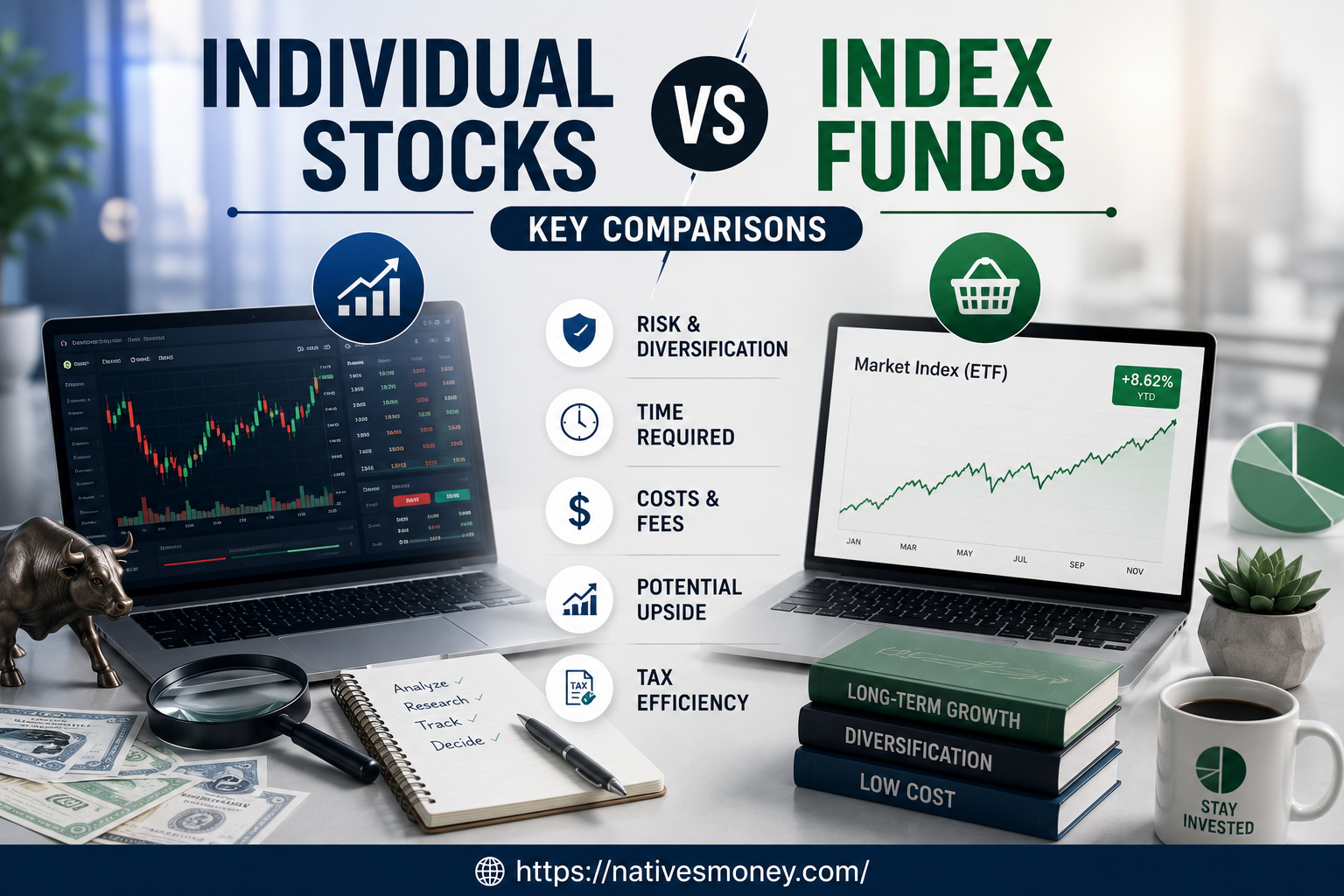
Here are the factors that actually matter when making this decision as a beginner.
Factor 1: Risk and Diversification
A single individual stock can lose 50-80% of its value in a year on bad news , a missed earnings report, a product recall, executive scandal, or sector downturn. This isn’t hypothetical. It happens regularly to well-known companies that seem safe.
An S&P 500 index fund has never permanently lost all its value. It drops during recessions and market corrections, sometimes significantly, but it has always recovered because it represents the entire US economy, not a single company’s fate. This is the core investing strategies argument for index funds , you eliminate company-specific risk by spreading across hundreds of companies.
Factor 2: Time Required
Serious individual stocks investing requires ongoing research. Quarterly earnings calls, competitive analysis, industry trends, management changes, the information that matters for stock picking changes constantly. Professional fund managers with teams of analysts still fail to beat index funds most of the time.
Index fund investing requires almost no ongoing time. You buy, you hold, you add more regularly. The S&P 500 rebalances itself, companies that shrink get smaller weightings, companies that grow get larger ones. There’s nothing to actively manage..
Factor 3: Costs and Fees
Individual stocks have no inherent ongoing fee once purchased (zero-commission trading is now standard at Fidelity, Schwab, and Robinhood). However, the hidden cost is the opportunity cost when your picks underperform the index.
Index funds have expense ratios , small annual fees expressed as a percentage. Fidelity’s total market index fund (FZROX) has a 0% expense ratio. Vanguard’s VTSAX is 0.04%. These are essentially negligible.
Factor 4: Potential Upside
Here’s the honest case for individual stocks: if you pick the right companies early, the returns can dramatically exceed any index. Amazon at $30 in 2001. Apple at $1 pre-split. Tesla at $20 in 2013. These are real examples of companies that delivered 10–100x returns.
The problem isn’t that this doesn’t happen. It does. The problem is that for every Amazon, there are dozens of companies that seemed equally promising and went to zero. Survivorship bias makes individual stock picking look more reliable than it actually is , we remember the winners, not the thousands of failed picks.
Factor 5: Tax Efficiency
Both individual and index funds generate taxable events when you sell. Long-term capital gains (held over one year) are taxed at 0%, 15%, or 20% depending on your income, significantly better than short-term rates.
Buying and holding individual stocks for years can be tax-efficient. Frequent trading, however, generates short-term capital gains taxed as ordinary income. Index funds held long-term, particularly in tax-advantaged accounts like a Roth IRA or 401k, are among the most tax-efficient investments available to retail investors.
My Recommended Approach for Beginners

Based on everything I’ve learned from my own mistakes and the research, here’s the framework I’d give any beginner.
Start with Index Funds as Your Core
For most beginners, a three-fund or even one-fund portfolio of broad index funds is the right starting point. A US total market index fund (like VTSAX at Vanguard or FSKAX at Fidelity), an international index fund, and a bond index fund provide global diversification at minimal cost.
This is the investment plan I’d implement before touching a single individual stock: get a meaningful portfolio of index funds established first, contribute to it consistently, and let it grow.
Add Individual Stocks Only After a Foundation Exists
Once you have a real investment planning foundation , at least $5,000-10,000 in broad index funds , it’s reasonable to allocate a portion to individual stocks if you’re genuinely interested in picking companies. I treat this as my “I’ve done real research and accept higher risk” bucket, capped at 10-20% of my total portfolio.
This approach lets you participate in individual company upside if your picks work out, while not putting your entire portfolio at risk if they don’t.
Choose the Right Platform
For index fund investing: Fidelity (zero-expense-ratio funds), Vanguard (the original home of index investing), or Schwab (strong index fund options, no account minimum) are all excellent choices for US investors.
For individual stocks: all three platforms work fine. Robinhood offers a beginner-friendly interface but fewer research tools. I’d recommend Fidelity or Schwab for investors who want decent research capabilities alongside their individual stock purchases.
Mistakes I Made Choosing Between Individual Stocks and Index Funds
Mistake #1: Starting with individual stocks before understanding what an index fund was. I didn’t even know what is index fund investing was until several months after I started picking individual companies. Learning this earlier would have immediately changed my starting approach.
Mistake #2: Concentrating too heavily in a single sector. My early individual stocks portfolio was almost entirely tech companies. Tech had a brutal 2022, and my portfolio reflected that much more painfully than a diversified index fund would have. Sector concentration multiplies risk in ways beginners often don’t anticipate.
Mistake #3: Selling index funds during corrections to buy “better” individual picks. I liquidated a portion of my index fund holdings during a market dip to buy specific individual stocks I thought were undervalued. In almost every case, the index fund recovered faster and more fully than my individual picks. Staying in the index would have served me better.
Mistake #4: Ignoring tax implications of frequent trading. I bought and sold several individual stocks within weeks of purchasing them, not realizing I was generating short-term capital gains taxed at my full ordinary income rate. Investment planning that accounts for holding periods and tax treatment matters significantly over time.
What to Realistically Expect from Each Approach
Here’s an honest picture of what historical data suggests for each path, with the caveat that past performance doesn’t guarantee future results.
Index fund realistic expectations: The S&P 500 has returned an average of roughly 10% annually over the past century (before inflation), with many individual years far above or below that average. Over a 20-year period, consistent index fund investors have historically done very well. There are no guarantees, but the long-term track record is the strongest in the publicly available investment universe.
Individual stocks realistic expectations: Some picks will dramatically outperform the market. Others will underperform or lose significant value. Research by SPIVA (S&P Indices vs Active) consistently shows that over 80-90% of actively managed funds , run by professional analysts , underperform the S&P 500 over a 15-year period. Individual retail investors with less information and resources tend to do worse than professional managers on average.
On the US tax side: when you sell either individual stocks or index funds at a gain in a taxable account, you owe capital gains tax. Gains from assets held over one year are taxed at the preferential long-term rate (0%, 15%, or 20% depending on total income). In a Roth IRA, gains grow entirely tax-free , which is why investing strategies that prioritize tax-advantaged accounts first are standard advice for US investors.
Best Tools for Index Fund and Individual Stock Investors

Fidelity is my top pick for beginners who want to invest in both index funds using their zero-expense-ratio funds and individual stocks, all in one account with no minimum.
Vanguard is the best dedicated home for long-term index fund investing , the company Jack Bogle founded is still the gold standard for low-cost, buy-and-hold index fund strategy.
Morningstar (free basic tier) provides useful fundamental analysis on individual stocks , earnings history, valuation data, analyst ratings, and competitive analysis , without requiring you to become a financial analyst yourself.
For more on building a complete investment plan from scratch, the Investments section at Natives Money has more practical guides built from real experience.
The Bottom Line
The honest answer most beginners need: start with index funds, build a real foundation, and only add carefully selected stocks once you have money you’re genuinely comfortable putting at higher risk. Most long-term retail investors would be better served by index funds than by individual stock picking—not because they can’t outperform, but because consistently identifying which ones will is genuinely difficult even for professionals.
Individual stocks can absolutely be part of a smart portfolio. They just shouldn’t be the whole thing, especially when you’re starting out. Build the index fund core first. Then explore individual picks from a position of strength rather than speculation. For more honest investing guides built from real experience, keep exploring nativesmoney.com.
Frequently Asked Questions
Are individual stocks better than index funds for beginners?
For most beginners, index funds are the better starting point than individual stocks because they provide instant diversification, require minimal research, and have a stronger historical track record for retail investors. While they can outperform dramatically, the majority of retail investors who pick them underperform a simple S&P 500 index fund over time.
What is index fund investing and how does it work?
What is index fund investing? It’s owning a basket of stocks that tracks a specific market index. When you buy an S&P 500 index fund, you own proportional shares in all 500 companies in that index. The fund tracks the index automatically without requiring active management decisions, keeping costs minimal and providing broad market exposure in a single purchase.
How does investment planning change if you choose individual stocks vs index funds?
Investment planning with index funds is simpler, choose a low-cost fund, contribute consistently, and hold long-term. Investment planning that focuses on individual companies requires ongoing research, monitoring of company performance, and active decisions about when to add or reduce positions. Most financial advisors recommend index funds as the core of any investment plan, with individual stocks as an optional satellite allocation.
What investing strategies combine both individual stocks and index funds?
A common investing strategies approach is the “core and satellite” model , a core of 80-90% broad index funds providing stable diversification, plus a smaller satellite allocation of 10-20% in individual stocks where you want to take calculated positions. This investment plan captures the stability of index fund investing while allowing participation in individual company upside.
Do individual stocks or index funds perform better over 10 years?
Historical data consistently shows that broad index funds outperform most individual stock portfolios held by retail investors over 10-year periods. However, individual stocks offer higher upside potential for investors who identify the right companies early. The tradeoff is that higher potential return comes with meaningfully higher risk and requires significantly more research time than index fund investing strategies.