

There was a point in my mid-twenties when I had $47 in my checking account , four days before payday. I wasn’t spending recklessly. I just had no system. And i kept telling myself I’d figure out how to save cash once I made more money. But more money came, and I still saved nothing.
That’s the trap most people fall into. They think saving is about income. It’s not. It’s about habit and intention. The amount doesn’t matter as much as the system behind it.
This article shares exactly what I learned , and what finally worked. Whether you’re starting from zero or just feeling stuck, I’m going to show you how to save cash in a way that sticks, even when your budget feels tight.
Why Most People Struggle to Save (And What’s Actually Going On)
Saving money sounds simple. Spend less than you earn. Keep the difference. Learning how to save cash is straightforward in theory , but most people never build the system that makes it automatic. But if it were that simple, 57% of Americans wouldn’t be living paycheck to paycheck right now.
The real problem isn’t willpower , it’s the system. Most people try to save whatever’s “left over” at the end of the month. Spoiler: there’s never anything left over. Life fills the gap every single time.
The smarter approach flips the order entirely. You save first, then you live on what remains. Understanding how to save starts with this shift. It’s the foundation of every solid money management tip I’ve ever come across. When you treat savings like a bill you have to pay , not an optional extra , everything changes.
Good tips for saving money aren’t about deprivation. And figuring out how to manage money doesn’t require a finance degree. They’re about design. Design your finances so saving happens automatically, and you’ll make real progress without relying on motivation that comes and goes.
How to Save Cash Step by Step: A System That Works
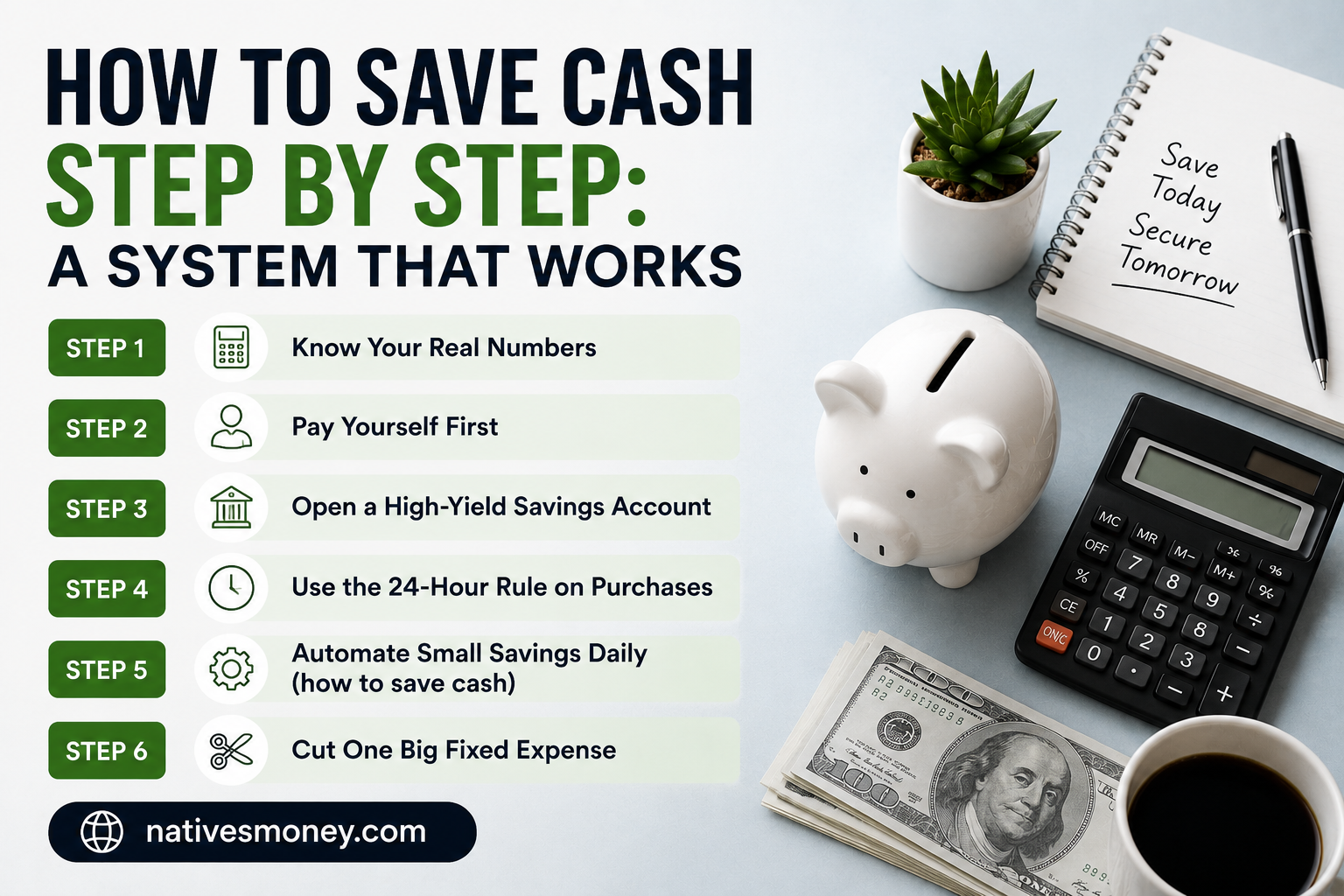
Step 1: Know Your Real Numbers
Before anything else, you need to see where your money actually goes. This is step one if you want to know how to save cash consistently. Pull up your last 60 days of bank and credit card statements. Add up your income. Add up every expense. Most people discover two or three categories where they’re leaking money without realizing it.
I did this exercise when I first got serious about how to save cash, and found I was spending $340 a month on subscriptions , most of which I’d forgotten I had. That’s one of the fastest ways to free up cash without changing your lifestyle at all.
Step 2: Pay Yourself First
This is the most powerful how to save moves I ever made. On every payday, the first transfer I make is to savings , before I pay any bill, before I buy anything. I treat it exactly like rent: non-negotiable.
Start with a small amount you won’t even miss. Even $25 per paycheck builds the habit. Once the habit is solid, increase the amount. Apps like Chime and Ally Bank make this automatic , your paycheck hits and a portion moves to savings before you can touch it. This single habit is the core of how to save cash without relying on willpower.
Step 3: Open a High-Yield Savings Account
If your savings are sitting in a traditional bank account earning 0.01% interest, you’re losing ground to inflation every month. High-yield savings accounts (HYSAs) at online banks like Marcus by Goldman Sachs, Ally, or SoFi pay significantly more , often 4–5% APY in recent years.
This is one of the most underused money management tips around. You’re saving anyway , you might as well earn real interest while you do it. All these accounts are FDIC-insured up to $250,000, so your money is completely safe.
Step 4: Use the 24-Hour Rule on Purchases
Impulse spending is the silent killer of savings goals. I implemented a simple rule: any non-essential purchase over $50 gets a 24-hour waiting period. Most of the time, I don’t buy it after sleeping on it.
This one habit helped me figure out how to save cash without feeling like I was sacrificing anything meaningful. The things I genuinely wanted after 24 hours , I bought them. The impulse buys , they disappeared on their own.
Step 5: Automate Small Savings Daily (how to save cash)
Micro-saving apps like Acorns and Qapital work by rounding up your everyday purchases and saving the spare change. A $4.60 coffee rounds up to $5.00, and $0.40 goes into savings automatically. It sounds tiny , but over a year, these small amounts add up to hundreds of dollars you never missed.
This approach works especially well if you find traditional budgeting overwhelming. It’s one of the easiest ways to build passive saving habits without constantly thinking about it. Once it’s set up, saving happens in the background automatically, making it effortless and consistent over time.
Step 6: Cut One Big Fixed Expense
Most money management tips focus on cutting lattes and skipping lunches. But the biggest wins come from cutting fixed monthly costs. Think: car insurance, phone plan, streaming bundles, gym memberships.
I called my car insurance company and asked for a lower rate, and they gave me one—I just had to ask. Then I switched to a cheaper phone plan through Mint Mobile and saved $50 a month instantly. Small habits matter, but renegotiating fixed expenses delivers faster results with less ongoing effort.
Saving Money Mistakes I Made (So You Don’t Have To)
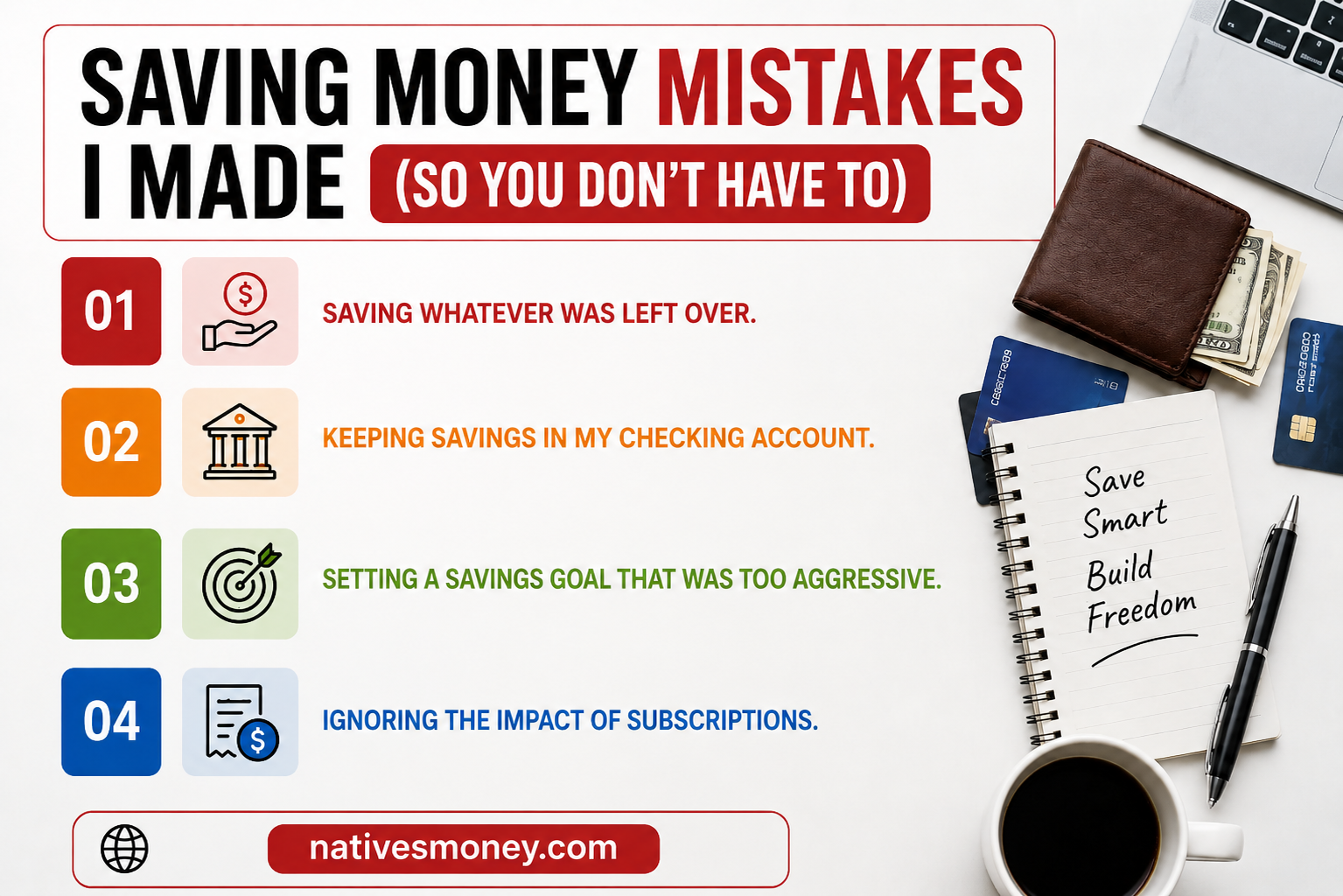
Saving whatever was left over. For years, I tried to save at the end of the month. There was never anything left. Saving first , even a small amount , is the only system that consistently works.
Keeping savings in my checking account. When savings and spending money live in the same account, savings disappears. A separate account, ideally at a different bank, creates just enough friction to protect your money from yourself.
Setting a savings goal that was too aggressive. I once decided I was going to save $1,000 in 30 days , on a budget that genuinely couldn’t support it. I failed, felt bad about it, and quit saving entirely for two months. Realistic goals build momentum. Unrealistic ones destroy it.
Ignoring the impact of subscriptions. Streaming services, app subscriptions, gym memberships, cloud storage , they stack up quietly. Audit yours every few months. Apps like Rocket Money (formerly Truebill) find and cancel forgotten subscriptions for you automatically. Most people overlook this one completely.
What to Realistically Expect When You Start Saving (how to save cash)
Here’s the honest version: saving feels slow at first. The first $100 takes effort. The first $1,000 feels like a milestone. Then something shifts.
If you save $200 a month consistently, here’s what that looks like:
- 3 months: $600 , a solid starter emergency cushion
- 6 months: $1,200 , enough to cover most unexpected expenses
- 12 months: $2,400 , a real financial foundation
These aren’t life-changing numbers yet. But knowing how to save consistently changes how you feel about money. You stop reacting to every unexpected expense with panic. That shift in confidence is what makes bigger financial moves , investing, starting a business, buying a home , actually feel possible.
One US-specific note: interest earned in a high-yield savings account is taxable income. You’ll receive a 1099-INT form if you earn over $10 in interest. Factor this in, especially if your HYSA earns a meaningful amount. It’s still worth it , but be aware at tax time.
Best Tools to Help You Save Cash in 2026 (how to save cash)
Ally Bank , My top pick for a high-yield savings account. Consistently competitive APY, zero fees, no minimum balance, and you can create multiple savings “buckets” for different goals. Easy to set up and genuinely useful.
Rocket Money , Finds and cancels subscriptions you’ve forgotten about, tracks your spending, and helps you set savings goals. Free tier available. Building financial success starts with knowing where your money goes , and this app makes that effortless.
Qapital , A rules-based savings app that automates micro-saving based on your spending habits. You set the rules, it handles the saving. Great for people who struggle with traditional budgeting.
For a deeper dive into building long-term money habits alongside your savings, I’d recommend reading money management tips for better financial stability on Natives Money. It covers the bigger picture of how saving fits into a complete financial plan.
Also worth bookmarking: financial planning tips for money management and smart savings strategies that actually work , both packed with next-level tactics once you’ve built the basics.
The Bottom Line
Learning how to save cash isn’t about being perfect with money , it’s about building a system that works even when you’re not. Automate what you can. Cut what you don’t need. Put your savings somewhere it earns real interest. And start before you feel ready.
The best time to start saving was yesterday. The second best time is right now , even if it’s just $20 this week.
Explore more practical money guides at nativesmoney.com , built for real people who want to grow their income and stop living paycheck to paycheck.
FAQ
How do I save cash when I’m living paycheck to paycheck?
Start smaller than you think you need to. Even $10 per paycheck builds the habit over time. Open a separate high-yield savings account, set up an automatic transfer on payday, and treat it like a non-negotiable bill. The key is consistency, not the amount—once the system runs on autopilot, saving becomes effortless even on a tight budget.
What are the best tips for saving money fast (how to save cash)?
The fastest tips for saving money are: audit and cancel forgotten subscriptions (apps like Rocket Money do this automatically), switch to a high-yield savings account, automate your savings before you spend, and renegotiate at least one fixed monthly expense like car insurance or your phone plan. These moves deliver results in days or weeks, not months.
How much money should I try to save each month?
A common guideline is the 50/30/20 rule: 50% of take-home pay for needs, 30% for wants, and 20% for savings. But if 20% isn’t realistic right now, start with 5% or 10%. What matters most is the habit of saving consistently, not the exact percentage. Increase it gradually as your income grows. This is one of the foundational money management tips that financial experts consistently recommend.
Does a high-yield savings account really make a difference?
Yes , significantly. If you have $5,000 in a traditional bank earning 0.01% APY, you’d earn about $0.50 in a year. The same $5,000 in an HYSA at 4.5% APY earns $225. That’s real money for zero extra effort. Opening an HYSA is one of the simplest how to save moves you can make today.
How do I build financial success through saving (how to save cash)?
Financial success through saving starts with consistency rather than perfection. First, save early on every payday and make it a non-negotiable habit. Then, keep your savings in a separate account to reduce the temptation of spending it. Additionally, track your spending each month so you clearly understand where your money is going. Over time, gradually increase your savings rate by just 1% every few months, which feels small but creates a powerful long-term impact.
As this habit strengthens, your savings begin to fund your investments. In turn, your investments start to generate additional growth and support your financial freedom. Ultimately, the habit you build today becomes the foundation of every bigger financial success story tomorrow. Therefore, it all begins with saving consistently and staying patient with the process.