
I used to think monetizing a blog meant picking one method and sticking with it forever, like choosing a career path. I was wrong. The truth is that ads, affiliate links, and digital products all play a different role at a different stage of your blog’s life, and most bloggers who actually earn real money end up using all three eventually.
If you’ve been staring at your blog wondering which method to start with, or whether digital products are worth the extra effort compared to just slapping ads on your site, I’ve spent enough time testing all three to give you a real answer instead of a generic one. This isn’t a theory, it’s what actually happened when I tried each one on my own blog.
By the end of this, you’ll know exactly which method to start with based on where your blog is right now, not where you wish it already was. I’ll also cover where some of the best ai writing tools genuinely help speed up building digital products, and where they don’t help at all, because that distinction saved me a lot of wasted time later.
I want to be upfront that this isn’t a “pick one and ignore the rest” article. Most of the best websites and blogs I’ve studied over the years eventually run all three methods side by side, just introduced in a deliberate order instead of all at once. That order matters more than people realize, and getting it wrong is exactly what slowed me down in my own first year.
Ads vs Affiliate vs Digital Products, Explained Simply

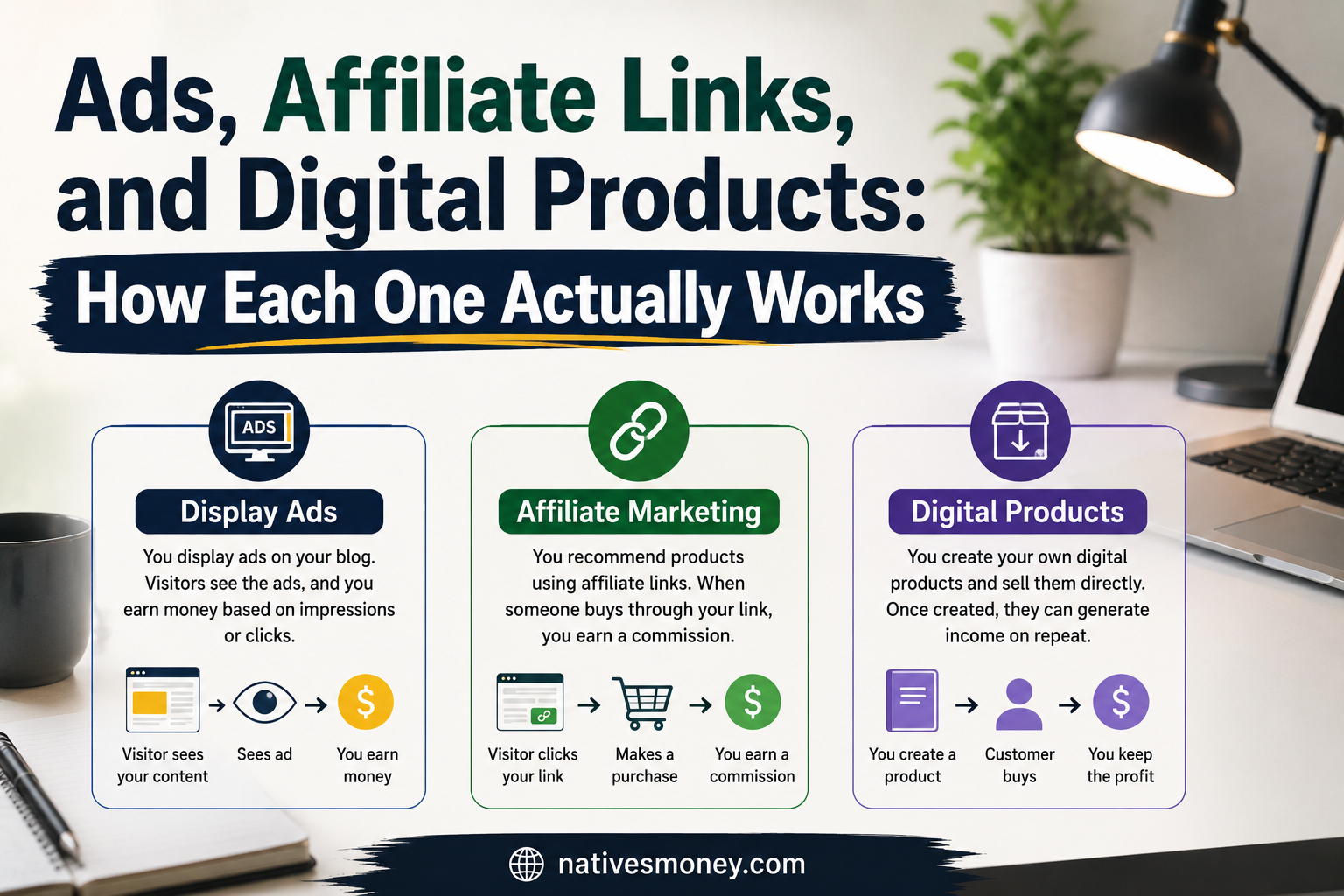
Think of these three methods as three different jobs you can hire your blog to do. Display ads are like renting out a small billboard on your site, you get paid based on how many people walk by, regardless of whether they trust you. Affiliate links are more like a personal recommendation to a friend, you only get paid when someone actually acts on your suggestion because they trust your judgment. Digital products are like opening your own small shop inside your blog, you’re selling something you made yourself.
This distinction matters a lot when you’re figuring out how can i start a blog that actually earns money instead of one that just sits there looking nice. Ads need traffic volume before they pay meaningfully. Affiliate links need trust more than traffic. Digital products need both trust and a genuine understanding of what your specific readers are struggling with.
Most of the best websites and blogs I follow closely didn’t start with all three at once. They picked the method that matched where they already were, built momentum, and layered in the others once the foundation was solid.
Ads, Affiliate Links, and Digital Products: How Each One Actually Works
Let’s break each method down individually, since lumping them together is where a lot of beginners get confused.
Display Ads
Ad networks like Mediavine or Ezoic place ads on your site and pay you based on impressions and clicks. This method is genuinely passive once it’s set up, which is its biggest appeal. The catch is that most quality ad networks require a meaningful minimum traffic threshold before they’ll even accept you, often somewhere around 25,000 to 50,000 monthly sessions.
Ads also tend to slow your site down slightly and can clutter the reading experience if you’re not careful about placement. I’d treat this as a method you add later, not one you build your entire strategy around from day one.
I applied to my first ad network far too early, back when my blog had barely a few hundred monthly visitors, and got rejected immediately. It stung at the time, but looking back it was the right call on their end. Ads simply don’t pay meaningfully at low traffic, and chasing them before you’re ready just distracts you from the content and trust-building that actually gets you there faster.
People often ask me how much are google ads, assuming display ads on their own blog work the same way as running paid Google Ads campaigns. They don’t. Display ad networks pay you for showing ads, while Google Ads is something businesses pay to run their own ads, and understanding how much do google ads cost as an advertiser actually helps you write better content if you ever cover paid marketing topics for your readers.
For context, how much do google ads cost varies wildly by industry and keyword competition, often anywhere from under a dollar to well over fifty dollars per click in competitive niches like finance or insurance. If you’re wondering how much are google ads for your own small business promotions, expect to set a daily budget and treat your first month as a test, not a guaranteed win.
Affiliate Marketing
Affiliate marketing pays you a commission when someone buys something through your link. Networks like Amazon Associates, ShareASale, and Impact are common starting points for American bloggers. This method only needs trust, not massive traffic, which is exactly why I started here first on my own blog.
The key is recommending things you’ve genuinely used or would confidently recommend to a friend, not just whatever pays the highest commission. Readers can tell the difference, and it quietly damages the trust that makes affiliate income work in the first place.
One thing I didn’t expect starting out is how much affiliate income depends on the specific moment in someone’s research. A reader comparing two tools right before making a decision converts far better than a reader casually browsing, which is why I now write comparison-style posts more often than generic “best of” roundups. It’s a small shift in framing that made a real difference to my numbers.
If you’re just getting started, look specifically for affiliate marketing programs for beginners that don’t require a large following or a long approval process. Amazon Associates, ShareASale, and Awin are all solid affiliate marketing programs for beginners because they accept smaller sites and offer a wide enough range of products that you can usually find something relevant to your niche. I’d also recommend keeping a loose eye on affiliate marketing news every so often, since commission rates, cookie durations, and program rules do change, and staying aware of affiliate marketing news has saved me from a few unpleasant surprises when a program updated its terms without much warning.
Digital Products
Digital products are anything you create once and sell repeatedly with no ongoing production cost, templates, printables, checklists, mini-courses, or even simple ebooks. This is the method with the highest margin, since there’s no middleman taking a cut and no physical inventory to manage.
Digital products take more upfront work than the other two methods, since you’re building something from scratch instead of just placing a code snippet or a link. But once it’s built, digital products can keep selling for years with almost no additional effort, which is a very different kind of income than trading your time for a commission or a click.
This is really the clearest answer to how to make money from blogger blogs once you’re past the very early stage of just publishing posts and hoping for traffic. A single well-made digital product can quietly sell while you sleep, while you’re on vacation, or during a week you barely touch your blog at all. I didn’t fully believe how to make money from blogger blogs could work this passively until I saw my own first template sell three times in a single day. I never even opened my laptop.
The other advantage digital products have over the other two methods is pricing control. With ads, the network sets your rate. With affiliate links, the merchant sets the commission. With digital products, you decide the price, which means you can actually raise it as you build more authority and trust, something neither of the other two methods really allows.
Learning how to sell digital products well took me longer than actually building them. The building part is mechanical, write the checklist, design the template, record the mini-course. Figuring out how to sell digital products in a way that doesn’t feel pushy, through a genuine email sequence and a clear product page that explains exactly who it’s for, is the part that actually moves the needle on sales.
Where Best AI Writing Tools Fit Into This
Here’s something that changed how fast I could build digital products specifically. I now use some of the best ai writing tools to draft outlines for templates, checklists, and mini-courses, then heavily edit the substance myself so it still reflects my real experience. This cut my product creation time roughly in half compared to when I built everything manually from a blank page.
The same applies to affiliate content and even ad-supported blog posts. The best ai writing tools speed up the first draft of almost any content type, but the actual value, the part readers pay for or click on, still comes from the specific, honest details only you can add.
Common Mistakes I Made Comparing These Three Methods

Mistake one: adding ads too early. I applied to an ad network at month two with barely any traffic, got rejected, and wasted time chasing a method my blog simply wasn’t ready for yet. Ads work best once you already have meaningful, consistent traffic.
Mistake two: promoting affiliate products I hadn’t actually used. I recommended a tool once purely because the commission was high, and it was obvious in the writing that I didn’t really know the product. That post was worse than almost anything else I’ve published.
Mistake three: underpricing my first digital product out of fear. I priced my first template at $7 because I assumed nobody would pay more. A similar template priced at $27 later sold almost as often, with far better margins, and buyers seemed to trust the higher-priced version more, not less.
Mistake four: trying to launch all three methods in the same month. I once tried to add ads, three new affiliate partnerships, and a new digital product all within a few weeks. Nothing got the attention it needed, and all three underperformed compared to when I focused on one at a time.
Mistake five: using best ai writing tools to generate my entire product without editing it. Early on I got lazy and let an AI tool write almost an entire checklist product with barely any changes from me. It sold worse than my other products and generated more refund requests, which taught me that even the best ai writing tools need real editing before anything goes out with my name on it.
What to Realistically Expect From Each Method
I want to set honest expectations here, because most articles about monetization skip straight to best-case numbers. My blog made $0 for the first four months, full stop. Affiliate income was the first to show up, bringing in just under $80 by month five.
Digital products came next, once I had a small but loyal email list to sell to directly. My first product brought in around $150 in its first month, then kept selling steadily afterward with essentially zero ongoing work beyond the occasional customer question. Ad income was the slowest to matter, since it needed traffic I simply didn’t have until closer to the one-year mark.
Combined, all three methods together crossed $600 in a single month around month ten, which was the first point it started feeling like a real, if modest, income stream. On the US-specific side, all of this counts as reportable income to the IRS from the very first dollar, whether it comes from ads, affiliate commissions, or digital product sales, so keeping simple records early saves a real headache later.
Looking back at the full breakdown by percentage, digital products eventually made up the largest single share of my monthly income once I had three or four products live, even though they took the longest to start paying off. Affiliate income stayed steady but grew more slowly than I expected, and ad income, once it finally arrived, added a nice supplemental amount without ever becoming the primary driver. Your own mix will likely look different depending on your niche, but digital products consistently punch above their weight once the trust and audience are in place.
Final Tips and Tools I Actually Use
For affiliate tracking and link management, Pretty Links works well if you’re on WordPress and want cleaner, trackable URLs. For digital products specifically, Gumroad or a simple WordPress plugin like Easy Digital Downloads both handle payments and file delivery without needing a full e-commerce setup.
For the content creation side, I lean on some of the best ai writing tools for first drafts of product descriptions, checklists, and outlines, then rewrite the substance myself before anything goes live. If you’re still working out the fundamentals of how I can start a blog before you even get to monetization, my full step-by-step breakdown on Natives Money walks through that entire process.
Whichever tools you pick, treat them as support rather than the strategy itself. I’ve swapped tools multiple times over the years without it meaningfully changing my income, but every time I improved the actual quality of my digital products or the honesty of my affiliate recommendations, the numbers moved.
The Bottom Line
Ads, affiliate links, and digital products each solve a different problem at a different stage of your blog’s growth, and the goal isn’t to pick a winner, it’s to layer them in the right order. Start with affiliate income since it only needs trust, add digital products once you understand your readers deeply enough to build something they’ll pay for, and bring in ads once your traffic actually makes them worthwhile.
If you’re building toward one of the best websites and blogs in your niche, treat monetization the same way you’d treat content, one honest, well-timed step at a time rather than everything at once. Digital products, in particular, are worth the extra upfront effort, since they’re the one method that keeps paying you back long after the work is done. Explore more real, practical breakdowns like this one over on Natives Money as you build out your own strategy.
FAQ
Here are a few of the most common questions I still get asked about comparing ads, affiliate income, and digital products, especially from people still figuring out how I can start a blog in the first place.
Which is better, ads or affiliate marketing for a new blog?
Affiliate marketing is usually the better starting point for a new blog since it only needs trust rather than a large volume of traffic, while most quality ad networks require meaningful monthly sessions before they’ll even accept your site.
Are digital products worth it if I don’t have a big audience yet?
Yes, digital products can work well even with a small audience, since a loyal, trusting group of readers is often more valuable for direct sales than a large, less engaged one.
How can I start a blog if I’m not sure which monetization method to use first?
Focus on building genuinely helpful content and a small email list first, then add affiliate links once you have a few trusted recommendations, and consider digital products once you understand your readers’ specific problems well enough to solve them directly.
How to make money from blogger blogs if I’m using a free platform?
Blogger-hosted blogs can still support affiliate links and basic ad programs like Google AdSense, but most digital product tools and premium ad networks require a self-hosted platform, so migrating eventually is worth considering. This is one of the most searched versions of how to make money from blogger blogs, and the honest answer is that a self-hosted setup opens far more doors.
Do I need the best AI writing tools to build a successful digital product?
No, but the best ai writing tools can significantly speed up your first drafts for outlines, descriptions, and checklists, as long as you still personally edit and add your own real experience before publishing.
What do the best websites and blogs in a niche usually get right about monetization?
Most of the best websites and blogs I’ve studied introduce monetization methods gradually and match each one to their actual traffic and trust level, rather than trying every method at once before they’re ready for any of them.
How to sell digital products if I only have a small email list?
Focus on solving one specific, narrow problem your existing readers already have, then write a simple product page and a short email sequence explaining exactly who it’s for. Knowing how to sell digital products to a small, trusting list often converts better than a large, cold audience ever will.
Are affiliate marketing programs for beginners worth it if I only get a little traffic?
Yes, most affiliate marketing programs for beginners like Amazon Associates don’t require huge traffic to get approved, and even modest, trust-based traffic can produce steady commissions if you’re recommending things your readers actually need.
Should I follow affiliate marketing news even as a small blogger?
Checking affiliate marketing news every few months is worth it, since commission structures and program terms do change, and staying informed through affiliate marketing news helps you avoid losing income to a policy update you didn’t notice.
How much do google ads cost compared to what I could earn from digital products?
How much do google ads cost varies by industry, but as an advertiser you’re paying per click, while digital products earn you the full sale price after the platform fee, which is why many bloggers eventually shift more focus toward products they own instead of just answering how much are google ads for their own promotions. If you’re weighing how much are google ads against building a product you keep full control of, the product usually wins long-term.